I just discovered a new person today, and he's fucking awesome.
Watching Sundance channel today, I caught a biography partway through the broadcast called, 'Dreams With Sharp Teeth' about Harlan Ellison. I laughed at his ascerbic wit and colorful language, cheered his direct confrontation with opposing ideas, applauded his progressive, free-thinking worldview and heartily agreed with his full-frontal assault on the decline of American intellectualism (and apparent celebration thereof).
It wasn't till *after* all this that I discovered on the show that he's an unapologetic atheist who has fearlessly proclaimed his stance for years. This guy is a firecracker, and I love it. Here's an Ellison quote from the documentary,
Video excerpt from 'An Evening of Lively Argument'. M.I.T., Oct. 6th, 2001.
"See first of all I gotta tell ya I was raised a Jew, I am an atheist. I am not an agnostic, I am not one of the wusses that says 'well maybe'. You know. If there were a god, by now she'd have hit me with a bolt of lightning in the ass long since. So, I am an atheist. I'm a card-carrying, fully-bound, right out there atheist. Ok? Ok. And I know most of you are too but you don't want to cop to it because you're afraid everybody is going to say, 'Don't you believe in the Second Coming?'. I don't even believe in the first fucking-coming!'
Quoted from the 'Dreams With Sharp Teeth' interview:
"I find nothing more ridiculous and annoying than some guy who runs a 100 yards...runs a kickoff....back 105 yards from the endzone and drops to his knees and thanks God. Well that's foolish. God didn't do it he did it. Because if God did that for him you mean god was against the other team? God is that mean-spirited that he has nothing better to do on Sunday afternoon, then beat the crap out of a bunch of poor football players?"
Truth be told, he reminds me of myself in a way, and watching Harlan, I felt an unusual emotion: relief. There are people out there who aren't afraid to be the only dissenter in the room, and he's done it for years and in a refreshingly fearless manner. There is no time for fear or political correctness.
Harlan Ellison is a case study for the sharply-made point (the documentary is seemingly named to that effect), and the world needs people like him as much as the gentler types. I've commented on this at length in my recent blogs on 'tone'. People need to get over 'tone' and listen to content. I cannot count how many times someone rejected valid information simply because of tone, and continued to plod-on being wrong about some mundane topic, correction, pseudo-science, silly belief, etc.
What do I like about him? He says it like it is, or at the very least, how he sees it...unmitigated by nice language, religion, permission or the hurt feelings of dissenters, many of whom have no business making any informed contribution to the matter being discussed.
One anecdote I especially enjoyed from the biography was Harlan relating a story about an episode he wrote for Star Trek. He had described in the script some 'runes' which were part of the set, but apparently the set builder didn't know the word 'rune' and apparently could not spell 'ruin' properly. Instead of making stones with runic inscriptions on them, the setbuilder made 'ruins', or crumbling remnants of structures which weren't even in the script.
So, when people insist on accuracy in language, it's because language is the vehicle by which we communicate. That Star Trek set-designer, when confronted by a word he didn't understand, apparently didn't have the humility or intellectual curiosity to look up or verify the meaning of this word in the script. This mistake directly caused a waste of time, resources and effort, probably caused a lot of embarrassment, some choice words from Harlan no doubt and could possibly have cost a few people their jobs.
Words matter. Accuracy matters...even if it offends people to discover that they're wrong. Better to discover the mistake early and avoid a bigger mistake later.
I'm sad to say I'm only discovering Harlan Ellison now, but better late than never. That said, at least now I have a huge new list of books I can add to my Kindle for iPhone, and I have a lot of catching up to do. (Any recommendations as to which of his books to read first are welcomed).
I'll close with one more quote from Harlan's insightful interview:
"As long as you can blame everything on some unseen deity, you don't ever have to be responsible for your own behavior."
Hear, hear.
-dB-

Monday, May 24, 2010


Wednesday, May 12, 2010
Immigration Reform and 'Racism'.
I know this is a touchy subject, but it shouldn't be. I'm going to explain my position on immigration in general (namely illegal immigration). Please don't presume to know my opinion yet, as it's neither simplistic, absolutist or black and white. I assure you I am pro-*legal* immigration, being a product of immigration myself (Irish-Italian descent) like many of my fellow immigrants here in America.
This is a timely post, since there's a lot of protest and controversy right now surrounding Arizona governor Jan Brewer's SB 1070 Immigration Reform law, and what I believe to be yet another example of an unfair and unnecessary conflation of immigration reform and the charge of 'racism'.
Read on, if so inclined. I am going to draw contrast between how the laws affect legal American citizens, and how just how many laws are ignored simply being an illegal alien. Also, I am going to separate the myth of 'racism' with the very real and factual status of those who are here illegally, regardless of race. Lastly, I'll make the case that not everyone who comes here has good intentions.
Press on, intrepid reader, if you dare.
1. Do the nation's laws matter, and should they be upheld? Yes, assuming the laws are good laws (IE: the lawbooks are filled with outdated, archaic laws that nobody would dream of enforcing).
2. Are the laws we have working to the benefit of the U.S. and its citizens? (Yes, otherwise they shouldn't be laws, or at least, shouldn't be actively enforced). If the laws are being actively enforced, then it's probably a good idea to acknowledge and follow them, even if we as citizens disagree with them.
3. Is there a legal means to protest and change bad laws? Yes. This can be done by changing the law, removing bad laws, or simply not enforcing them. There are means by which citizens can practice peaceful protests or assemblies, and certainly our votes work toward changing laws we disagree with.
Indeed, laws do matter, especially if they are being actively enforced. Sure, there may be laws on the books about women hanging out near lamp-posts after dark, but nobody cares about this archaic nonsense. If these outdated laws were enforced, they would quickly become landmark cases and possibly make it to the Supreme Court, whereupon the outdated laws would quickly be deemed unconstitutional and used as precedence to overturn similar laws at no trivial taxpayer expense.
Still, other laws are being actively enforced (like prohibitions against car theft, for example) and should be upheld to protect the innocent from those who mean to violate their property rights. Laws against murder, identity theft, even child endangerment all make sense to us, and are actively and vigorously enforced.
Another example we face everyday as Americans is the national speed limit of 65 mph, whether we agree with it or not, it affects us every minute we operate a vehicle on public roads.
While I take issue with an arbitrary national speed limit which is supposed to apply in all situations, and where Germans drive faster per mile and with fewer accidents, the current 65mph national speed limit is in place. If you violate it sufficiently and in view of a cop, he/she will likely arrest you (pull you over), limiting your movement for the time being.
If you're stopped by a Law Enforcement Officer while driving on a public, taxpayer-funded (public) road, you'll be asked for the following papers before any other business is conducted:
1. Valid Driver's License
2. Valid vehicle registration
3. Insurance papers to prove minimum liability coverage (this social law is chiefly in place to protect others in case of an accident).
The officer will also take note of the following conditions:
1. Are you under the influence of drugs or alcohol?
2. Were you wearing your seatbelt as required by law (in applicable areas), or motorcycle helmet if on a motorbike? If not, there are penalties to be had and these can be cited.
3. Is your vehicle in violation of any other VC's (Vehicle Codes)? Perhaps your muffler isn't street legal, or your window-tint may be too dark, etc.
4. If you're carrying children, are they in violation of any airbag prohibitions for underage/underweight children, and if they're in the back, are they secured properly in seatbelts and in a child-carrier seat where applicable?
5. If you're carrying non-child passengers, are their seatbelts secured (in applicable areas), and are they holding any open liquor? Any suspicious behavior?
6 Is there any suspicious contraband (or behaviour from you) which would give probable cause for a search for drugs, contraband, guns or other illegal items/cargo?
And, it doesn't end there. This is the laundry-list of events which occur whenever you're stopped for what seems a routine traffic infraction, whether it's speeding at 100mph+ or having a broken lamp on your rear license plate.
While all of this may seem routine, it's only routine *if* this doesn't lead to the cop discovering other issues which may lead to more infractions on a citation or worse, impounding of your vehicle, arrest, Miranda warning and a trip to the detention facility. Someone's who got 'their papers' in order has little to worry about. They may or may not receive a citation (often based on their attitude) and if a citation is received, there is legal recourse to fight the ticket or simply pay it, take the point and higher insurance rates, and press on.
Note, that in order to qualify as an operator of a vehicle you're driving on public roads, you have to have driver training, which is how you get your license to begin with. The vehicle has to be legal, smog-checked and you have to be authorized to drive it, etc., which is handled by the registration process.
Of course, you need to prove liability for the vehicle you're operating, and that is handled through your insurance. Let the insurance lapse, and your registration will be suspended in some states, since the two are now linked together. Get caught driving without insurance and you face a hefty $1000 fine (or more) and 3 months of 'insurance probation' along with hefty rate hikes, and your car may be impounded as well.
The fact is, there are laws which govern what we can do even as American citizens, and violating these laws have consequences.
Now, why is it that people make such a fuss defending illegal immigration, and often hurl charges of 'racism' at those who notice or want to uphold laws which prohibit this federal crime?
There are numerous ways to legally occupy American soil. One can get a student visa, a work visa, a green card and all of these are potential paths to naturalization and citizenship.
If you drive a car, you have to generally be a U.S. citizen to even get a driver's license, otherwise it's a serious breach in protocol. How does one sneak into the country and yet drive on public roads and care about road rules and such trivialities such as speed limits if they're not even legal citizens? Why should American citizens of all stripe be scrutinized so intensely when they are stopped for speeding, an illegal u-turn or even for something so small as illegal window tint? Meanwhile, non-legal aliens flout these and greater laws, not even having bothered to become citizens which is a requirement to even be here, much less drive on public roads with the rest of us? Why do people dutifully pay speeding tickets, and yet whole groups of people seemingly defend those who run over the nation's borders as 'noble' exiles?
The same holds true for illegals and their various jobs, assuming they're making money through legal means. How does one work and pay into the system (through income tax) without being a legal citizen who can be hired legally and without penalty by employers? Sales tax of course takes care of itself, but nobody is exempt from income tax. And yet, that same person avoiding the legal path to citizenship and income tax will likely drive on public roads with unknown training (if any) and possibly make use of public services too, and some have the gall to shout epithets such as 'racist' if such abuses are recognized as such?
Naturally, one's legal status affects one's ability to drive and work, where the lack of legal status forces one to act outside the law and legal system. Those who steal 'citizenship' by way of illegal immigration are simply working outside the legal citizenship process already in place, and not only are these people unknown to the country and state they occupy, they're also in violation of Federal law. It's wholly unfair both to existing citizens and those trying to become legitimate citizens within the law for others to squat illegally and demand amnesty simply because their crime is 'in the past' and they're 'already here'.
The fact is this; America is not an open-border country and has a persistent and pervasive illegal immigration problem, mostly on its southern-border with Mexico. This does not speak to what illegal immigrants *do* when they get here (whoever they may be), only to the fact that these border laws exist, and there's no debate about that. This also doesn't necessarily mean that illegals are always Mexican, as anyone of any race who knows about the border weaknesses can hire a coyote or sneak across with others through Mexico...regardless of national origin.
Under Title 8 Section 1325 of the U.S. Code, "Improper Entry by Alien," any citizen of any country other than the United States who:
Enters or attempts to enter the United States at any time or place other than as designated by immigration officers; or
Eludes examination or inspection by immigration officers; or
Attempts to enter or obtains entry to the United States by a willfully false or misleading representation or the willful concealment of a material fact;
has committed a federal crime.
Violations are punishable by criminal fines and imprisonment for up to six months. Repeat offenses can bring up to two years in prison. Additional civil fines may be imposed at the discretion of immigration judges, but civil fines do not negate the criminal sanctions or nature of the offense.
There's the law, and anyone can verify this for themselves. There's no denying immigration laws exist. Any arguments FOR illegal immigration are generally not legal arguments but appeals to emotion and/or distractions to defend crimes of opportunity. This is why people unfairly toss the accusation 'racist' around, which is an emotional hot-button distraction and non-sequitur, designed to put the person noticing the violation of federal law on the defensive. This accusation rests on the knowledge that most modern Americans will do almost anything to avoid this label, even if it means putting their skeptical brains on hold with regard to illegal immigration. I wholly reject this association. Just as speeding tickets, accusations of theft or rape don't have anything to do with race, neither does the fact that millions of illegal aliens flow over under-protected borders every single year.
The fact is, we have borders by which our tax-money serves to protect and defend from incursion, especially in the wake of heightened security after the 911 attacks, and those laws were in place before 911. Should those laws be ignored? No. Do they serve a purpose in an attempt to protect legal American citizens? Yes. Should America have open borders? This is another debate, and I am open to it, but for now suffice it to say that America does have borders which are protected and should be honored.
The immigration laws serve another purpose, which is for the country to know just who wants in, be that student or rapist, cereal-farmer or serial molester, guest-worker or drug runner, car mechanic or car-thief, gardener or garden-variety terrorist. This shouldn't need explanation, but until we have open borders in America (which we don't), it does behoove us to know who is coming into the country. We Americans often lose our collective minds when the government wants to build prisons in or near our neighorhoods, and understandably....so why are so many people defending or promoting what seems to be an all-out attack on those who notice illegal immigration, comment on it, or want to simply enforce existing immigration laws?
While some romantically depict illegal immigrants as hardworking migrants who simply want a better life, and while this might be generally true, there are many who come here under stealth who are criminals of some ilk. The fact is, when someone crosses the border illegally having circumvented legal means, we just don't know what we're getting (apart from someone whose first action on American soil is to break federal law).
Illegal immigration, as the name implies, is illegal in a fundamental sense, where it's no different than just driving around on public roads in an unregistered car, without a license and without insurance. Illegal immigration is akin to squatting in a house you don't own, and is tantamount to theft of citizenship. At worse, the illegal immigrant group crossing U.S. borders could be seen as part of an invading squad or force, but that might be taking it too far. Still, when national laws are ignored, it's more than just a trivial problem.
So, before we even worry about WHO is coming over illegally, illegal immigration, by definition, is illegal and that is an established and uncontested fact.
Now, why do some people make such a fuss over the fact that a litany of requirements is needed to simply drive on public roads, but somehow others want to protect those who simply ran over the U.S. border, only to squat on U.S. territory and have the gall to ask for a 'path to citizenship'?
It's nothing less than intimidation, politically and at a grass-roots level. See, the problem is so bad now, so pervasive, that people are getting to where they are called 'racist' if they notice it, or if they want to do something about it. However, race is secondary, and a separate issue. Country of origin is noteworthy here since, as we all know, the U.S. shares a long border with Mexico, and this is where the huge majority of illegals filter in from. This doesn't indicate that all illegals are Mexican, simply that this is a known issue, statistically, due to simple geography and the poor economic state of Mexico, which lends itself to those seeking improvement in their lives without waiting around for pesky bureaucracy such as seeking legal citizenship, which can be tedious and time-consuming.
How is it racist to enforce national immigration law anymore than it is for a cop to pull me over for blasting 110 mph down the freeway? It isn't. Modern U.S. laws are not inherently racist, at least, the ones I am discussing aren't.
The problem is, those who identify *themselves* as targets of these laws are often generally themselves guilty of illegal immigration, or perhaps are friends with, or know or are aiding and abetting illegal aliens. These people affiliated with illegals are strongly discouraged from acting in the interest of national security but in self-interested opportunism, either to directly help those breaking these laws or as a convenient way to avoid confrontation with friends and family.
That sort of pressure is no small influence to those that are forced to live with and around a large constituent that identifies with the masses who simply came here illegally after circumventing the legal process, and are pressuring everyone else not to notice. This is much the same strategy used by the Catholic church to aid and abet child molesters. Don't notice, don't ask don't tell, don't talk about it. But, the problem still exists.
Ok, now many will make the ridiculous argument that those who come here illegally are just looking for 'a better life'. Granted. I agree that they are looking for a better life, but so is a car thief, the bank robber and the desperate would-be mom who steals a baby from a hospital.
All of them want to improve their situation (as do most criminals) at a direct cost to others. It's how they go about it, in violation of the law, which is the issue at hand. We don't fret about the race or gender of those who steal babies (usually females do this), because the issue is that we don't allow baby-theft in a civil society. We don't get hung up on the gender or race of the identity thief, because it's illegal no matter what your gender, race, etc. (though one could argue that illegal immigration largely feeds this criminal market). Likewise, illegal immigration is no different, and isn't primarily a racial issue, but a geographic and financially-driven issue.
When a car thief successfully steals your car, is there a path to ownership? No. The thief, if caught, will be apprehended for this crime and thrown in jail, with penalties matching the crime. If that car-thief happens to be an illegal alien, this will too be discovered by way of seeking identification and often, that criminal will likely be deported.
See, discovering one crime or infraction often leads to the discovery of others. It's no different than the cop who spots the somewhat innocuous driver with an expired registration, only to pull him over for a routine 'fix it' citation. If the officer spots a controlled substance such as a Marijuana joint, this could lead to a probable cause search, which could lead to a discovery of a cache of drugs in the trunk...maybe a gun or other contraband. Evidence is simply probable cause for discovery of other alleged wrongdoing simply by way of observation.
Why then would we be surprised if a traffic stop which *requires* a cop to ask for license, registration and insurance, and where none is provided, not lead to questions about citizenship? How else do we propose to discover who is an illegal alien, especially in border states where this is a much bigger problem than say, Iowa or Nebraska?
Why shouldn't the cop, who is canvassing the situation to see if you were not wearing a seat belt or talking on a non-hands-free cellphone (infractions in many states), also not check to see if you are even a legal citizen if you fail to provide a license, registration or insurance (or all of the above)? Why would we let a an officer of the law search a vehicle based on probable cause that you're carrying drugs or other contraband, but not be allowed to think too hard about whether you're here illegally, regardless of your race?
All criminal investigation requires profiling of some type. This is exactly what cops do, and if they didn't, they wouldn't be very good at their jobs. When there's a suspected rapist, most of the time the offender is going to be male, and understandably, the rapist will generally know his crime and be nervous around cops, especially if he knows people are looking for him. Anyone accused of this crime would have their description given to the cops, and if that happens to fit the descriptions of other accused rapists, so be it. It doesn't change the fact that the perpetrator will be brought to justice if caught.
If the crime is car theft, the stolen car in question is put into the system, and the cops on the hunt will profile ALL cars of that make, model and color in and around that area. If you happen to be the unlucky driver of that make model and color car, you might get pulled over while the cops look for the real perpetrator, but most civilians understand this inconvenience and would appreciate the same courtesy if their own cars were stolen.
In addition, almost any reported crime dispatched to Law Enforcement Officers will include descriptions of the physical characteristics of the perpetrator, including race and gender. To anyone who has eyes, this is useful information if you're looking for a suspect. Is the suspect tall, short? Black or white? Tattoos or any other noticeable markings? Does he dress a certain way? Drive a certain type of vehicle? Is he seen at a certain place regularly? As pattern-recognizing primates, these are all essential ingredients to finding perpetrators for detention and further questioning.
With regard to those who might be here illegally, there is also profiling which is necessary, and it's no more racist than profiling those who steal cars or transport controlled substances. Sure, an illegal alien could be Swedish, Russian, Chinese or Guatamalan, but that would only be a part of the equation, and this doesn't mean race is the *first* criteria in discovering illegals. While an illegal alien could be Swedish or Hungarian, we know that statistically and due to simple geography, illegal aliens in the U.S. border states are overwhelmingly Hispanic. A cop shouldn't be legally restrained from discovering an illegal alien through pertinent questioning when a driver fails to show valid ID, regardless of the driver's race. It's not wholly unlike screening for terrorists at airports. Statistically, airline terrorists aren't from South Wales or Iceland as much as they are generally Muslim extremists of 'Middle-Eastern' appearance, but that doesn't mean any suspicious persons won't be asked to comply with further screening 'as needed' to protect the rest of us from any perceived threats. I understand not all Muslim extremists are Arab-looking, but most are (certainly the 19 terrorists who blew up the trade-center were). I am not speaking in absolutes, but generalities here.
The cop isn't looking *first* for illegal aliens anymore than he's necessarily looking for those who might be hiding a loaded gun under their seat at a traffic stop. The initial contact with a civilian might simply be the cop citing for a broken taillight, exceeding the max speed, driving in the carpool lane solo, etc.
Once that stop takes place, however, it is NOT inherently racist for the lack of papers justifying operation of a vehicle on American public roads (license, registration and insurance) to lead to questions about citizenship status. This is simply one or more infractions leading to the discovery of others, as demonstrated above in any routine traffic stop. After all, why should someone who isn't even here legally be allowed to drive without the necessary requirements on public roads shared by the rest of us? How is this fair to anyone? We don't offer special dispensation to those who are legal citizens driving without a license, registration or insurance, so why should those who are here illegally not charged with the greater crime of being in the country after avoiding legal status in the first place?
Wouldn't it make sense that someone without any ID, registration and insurance is likely not a legal citizen or at least seriously in violation of the basic requirements to drive on public roads? If a legal citizen is cited for these infractions, the cop issues a citation after optionally impounding the vehicle and the accused simply gets his affairs in order before his driving privilege is restored. Naturally, someone who lacks any papers supporting his driving privilege who is not a legal citizen/resident has a lot more to lose, but I think it behooves us to allow cops to use their logical deduction and follow the evidence where it leads....and if that uncovers an illegal alien once in a while, so be it. After all, if we don't rely on cops to spot crime, then who should do it? Do we rely on vigilantism? I should hope not.
Perhaps, we've all been there in whole or part with missing documents in a routine traffic stop. Sometimes we let registrations lapse, forget to restore insurance coverage (an expensive lapse) or fail to renew our driver's licenses. But, most of us *have* some kind of driver's license, even outdated ones. Failure to produce any documentation, even outdated docs, would be probable cause for any officer of the law to then ask for Proof of Citizenship (were it allowed) just as they ask for POI (Proof of Insurance) in a normal traffic stop.
Again, for legitimate citizens, be they on work/student visa, green card, naturalized or full citizens, it's a legitimate question by those who represent the law. If a cop, who is merely a witness in this case, cannot ask you for your proof of citizenship, then effectively *nobody* can. Think about it, if a cop cannot see who the legal residents are, do we rely on the secretive witch hunts and have neighbors reporting on neighbors, who then have to deal with the I.N.S.?
This is where things get silly, as people cry 'racism' at the notion that one infraction should not be allowed to lead to the discovery of another. As we already know through routine traffic stops, this happens *every day* to legal citizens driving their vehicles on public roads. The cop might pull you over for a broken tail-light and discover you have no insurance and are carrying pot. Small problem leads to a bigger problem. He may run your plate before stopping you and find a warrant for your arrest. Bad luck, bad timing, but the cop still was able to find you in the system and get information on you.
With illegal aliens, no such information exists, the illegal likely has no paperwork, or illegitimate/fake paperwork, and we're supposed to ignore this, or pretend it's not a problem? I heartily disagree. Checking legal residency/citizenship status could be as simple as having a driver's license or state ID which is already required to drive on public roads. Showing proof of citizenship should be a basic requirement *when asked*, as there's a known issue with illegal immigration in America, moreso in border states. This problem has a cascading effect in other areas, as I'll explain below.
The basic legal status of an individual should pre-date any license, registration or insurance requirement anyway, since it seems illogical to grant all of these papers to someone who snuck into the contry in the first place.
It's somewhat like granting a driver's license to someone who has escaped jail....that person isn't even supposed to be out of jail, let alone driving on public roads. It's a simple cart before the horse issue. First: citizenship, second driver's license and other rights afforded to legitimate American citizens.
Now, I realize this is a huge blog entry already, but I feel the need to address some of the 'defenses' of illegal immigration. Remember, there is no disputing that immigration laws exist, and once violated, the illegal alien is now in violation of a federal crime. But, let's answer a few objections to those who seek to circumvent the path to citizenship by simply sneaking into the country by various means.
Don't these illegal immigrants just want a better life? What's wrong with them coming over?
My first response is to reject the assumption that all illegals are simply here to do noble deeds, go to work, and send money to their families when their very first action on American soil is to break federal law by circumventing the legal path to citizenship. We don't know who is coming over when we don't know who is coming over....they could be workers, rapists, families or terrorists. I support the current laws and the government wanting to know who is coming into the country. Breaking the law to get into America is obviously a pursuit for a better life, but it impinges on the right of America to be a sovereign nation with protected borders. It cuts in front of those waiting patiently for legal citizenship by way of occupation, and like the car thief or land-squatter, obviously people will break the law to have a better life, but it's no excuse. Again, we don't offer car thieves and land-squatters 'paths to ownership', just as we shouldn't offer illegal aliens paths to citizenship ahead of those using legal means to become Americans.
Additionally, living outside the law as a fugitive has a cascading effect on the lives of others. For one, it means you're probably not trained to be driving on American roads, and lack some of the training about drinking and driving, seatbelt laws, and other provisions that every legal American must abide by. Yet, many of these illegal aliens will drive anyway and 'take their chances' which is really putting everyone else at risk, not to mention clogging roads with drivers of questionable driver training, if any.
Worse, being a fugitive means the illegal alien driver is more likely to drive off in the event of any kind of accident, for fear of arrest and deportation.
Paul Babeu, an Arizona Sheriff from Pinal County explains:
'Last month alone, just in one patrol region, we had sixty-four pursuits. That means people who were driving a vehicle, failed to yield, took off like a bat out of hell, running red lights, creating traffic wrecks, numerous people were killed in these wrecks over the last several months, and who are these people? Not one of them was a U.S. citizen'.
Here's the article link, for those who want to read more. Check out this YouTube audio file below for the interview with Pinal County Sheriff, Paul Babeu, who discusses illegal aliens involved in high-speed pursuits and the issue of 'racial profiling'.
Clearly, there is a trend here. Illegals don't want to be caught, and it affects *everyone*.
Apparently it's not just car chases. Here's an exerpt from Sheriff Babeu's own website,
'At approximately 4 PM on April 30th, Deputy Louie Purrol was tracking six drug smugglers (later known to be armed) in the remote desert area south of I-8 and west of Casa Grande, when he was ambushed and shot. Over 200 officers from local, state, tribal nations and our federal partners responded. Your help and support was tremendous and underscored the strength of our professional bond.
Though the investigation continues, we have several investigative leads and have identified three other Mexican Nationals, who are victims (robbed of cash and personal belongings) of the same suspects that shot Deputy Purrol. The Border Patrol apprehended two of four (two escaped) illegals along this smuggling corridor and recovered four fully loaded AK-47s in the three points area, located along the Pima/Pinal border. Two illegal immigrants with felony drug trafficking (cocaine) warrants out of the mid-west were also apprehended within our security perimeter. There were over 100 illegals apprehended within our security perimeter in the remote desert area south of I-8 and west of Casa Grande, just within 24 hrs we were there'.
Noble migrant workers, or invading militia? Perhaps a bit of both? The fact is, America has a right to know who is coming into the country, and American ciizens deserve to have a protected border if we're going to bother having a border at all. No wonder people in border states feel uneasy, and it explains new laws like the one Gov. Jan Brewer signed into law on April 23 (SB 1070), which would make illegal immigration an Arizona state crime (not just a federal crime), and allow checking of legal status once criminal investigation is underway.
As Sheriff Babeu says in the YouTube clip, he doesn't profile by race, he profiles criminals. That's exactly what our tax-dollars pay cops to do. If they can't use their intellect to catch criminals, then who should do it? Pretending not to notice Federal crime might be convenient for illegals, but it doesn't do American citizens much good.
Don't these illegal immigrants just want to work? They perform work service that American citizens don't want to do themselves.
While the romantically-portrayed migrant worker does provide a service (while avoiding income taxes as many are paid in cash or under-the-table), there are others coming over who are murderers, violent criminals, child molesters, rapists, terrorists, drug-runners or involved in other black markets, car thieves, etc, not to mention already guilty (by definition) of a federal crime of illegal occupation on American soil. For those who have the stomach to look, there are pages of criminals on the web who were apprehended and found to be illegal aliens.
While many will talk about illegal immigrants performing jobs that others 'won't' perform, this is a self-fulfilling prophecy in large part. This is due to the fact that someone who isn't here illegally doesn't have the benefit of American legal protections, risks deportation by being exposed as an illegal alien, and is easily exploited and underpaid. This limits the means by which a legitimate American citizen can compete with the under-the-table wages paid to illegal aliens, as legal aliens and citizens are guaranteed a minimum wage, but illegals often work for much less outside the system.
Fugitive labor comes at an astonishingly low-cost, and there's just no way for American workers to compete for that job at such a low wage. That holds true for new American citizens who are still working low-wage jobs, but who have legal recourse, a guaranteed minimum wage, established break-time, OSHA protection, etc. The illegal will always be exploited and motivated to undercut and work for less. This really does affect citizens who might otherwise work these jobs but for unscrupulous companies hiring cheap, illegal labor.
Weren't indigenous American-continent Hispanics or Native Americans here before the Europeans? What's the big deal with them coming back?
I've heard this argument before relating to 'Hispanics' coming back to occupy land which was 'taken' from them through past wars and such. To this I reply, 'It doesn't change the fact that America is a sovereign nation, with borders and border laws'.
The unfortunate fact of territory is that it changes hands from time to time, through war, purchases and other means. While it is true that the Americas were originally native American, this changed with the incursion of Spanish and their superior technology, not to mention their New World diseases wreaking havoc on indigenous populations. Native Americans or 'Indians' in common parlance, were forcibly converted to Catholicism and raped (along with consensual breeding), and this is responsible for the various gene-mixing we've come to know as 'Mexican' and other Hispanic peoples living in the Americas.
The native-Americans themselves weren't always here, but came from Africa (like the rest of us) by way of Mongolia and then through the Bering land bridge, which can be verified through population genetics or Mitochonrdial DNA comparisons. This is why Native Americans have an 'Asian' look, their ancestors were from Asia.
That said, if the intent by illegals is to simply re-occupy their former territory, then that is an act of war, even if it's not recognized as such by others or declared as such. However, I have heard various Hispanic militants on the radio claiming that while the intent isn't overtly war, there is a movement among a subset of illegals to out-populate and occupy lands which were formerly theirs. I am not saying that all illegal aliens feel this way or even know about these sentiments, but it is out there. This attempt to re-populate again, isn't always as innocent or noble as defenders of illegal immigration make it out to be.
To be fair though, out-breeding has as much to do with socio-economic status as anything else, as throughout history the poor, religious (namely Catholic) and less-educated have always had far more children than the well-to-do. It stands to reason that those who are fleeing disastrous economic conditions in their home countries are poor, and many families are under the thumb of Catholicism or simply under-educated about birth control. There's also the strategy of having American-born, aka 'anchor babies' as a way to secure provisional citizenship and/or complicate deportation, so it's far from a simple problem with a simple solution, at times.
Lastly: the general drain on resources. Where does the illegal immigrant go for healthcare, and how does that affect the already 45 million legal citizens who don't have healthcare? My guess at the very least, illegal immigrants tend to use Emergency Rooms as their primary care, but this affects everyone with regard to wait time and overcrowding, not to mention cutting into profits and thinning the efforts of an already over-burdened staff. Where do illegal immigrant children go to school, and how much of a burden does this put on instructors who are already underpaid, but now potentially have to teach in two languages? How much traffic are Americans willing to deal with, without those who are fugitives creating more traffic along with everyone else if they're driving on public roads, with an unknown level of driver training? I am sure I could think of more examples, but you get the picture.
There are a lot more repercussions for illegal immigration, but the fact is, the term is self-described as 'illegal' immigration, regardless of race. I am all for legal immigration through proper channels. Likewise, if I were going to go to France or the U.K., I would expect to have to acquire citizenship through proper legal channels as well, and I wouldn't protest in the streets with an upside-down flag of my unknowing 'host' country just because a crime of illegal immigration was recognized and punished as the crime it is.
Let's be real here. The charge of 'racism' for recognizing illegal immigration is an erroneous conflation of two separate ideas. Perhaps, a more likely term would be 'citizenist', which would at least be accurate. Those who shout 'racist' are revealing more information about themselves and their association with race and illegal immigration than anything else. It's a classic case of, 'I resemble that remark!'.
If legal American citizens have to abide numerous rules and regulations just to drive a car on public roads, then it should be behoove us as citizens to allow our police to also check for citizenship at routine traffic stops, if warranted by those we appoint with the power to check your license, registration, insurance, seatbelts, etc.. After all, if someone is simply squatting within sovereign borders, why on Earth are they here driving around? Simply 'getting away with the crime' is not a free pass. If we disallow the police this power to pursue evidence, then how should we else does the law propose to discover someone's legal status?
One solution regarding traffic stops and legal status would be to allow police to ask about your citizenship *if* one fails to provide any driver's license or state ID, or if that ID appears to be fake in some manner. I think this is reasonable, and that kind of question about citizenship or residency status would only come as a result of some breach in protocol, where you're caught in an infraction/crime, come into contact with police and fail to provide proper ID. Of course, not being able to speak the language is a strong indicator that you haven't been in the country very long either, just as smelling of alcohol might be an indicator that someone's been drinking...another thing cops have every right to investigate further.
Sure, being an illegal alien isn't directly a cause of injury like drinking and driving, but like someone driving with a warrant, it's certainly a reason that person should be detained by the cops and dealt with should this fact be discovered. Even lying to a cop about your name can be used against you, so being in the country illegally shouldn't be exempt from scrutiny.
Bottom line, legal status has zero to do with racism, but is a natural extension of enforcing existing federal law. People should not be intimidated by charges of 'racism' for noticing this crime anymore than noticing other crimes.
Regardless of race, someone who is here illegally is just that, here illegally and thus the term *illegal* immigrant. It's fairly simple, and confers nothing about idea relating to the superiority of any race which is the erroneous idea 'racism' actually refers to.
As for legal immigration, I'm all for it. It takes time and effort, but few things worthwhile come easily.

This is a timely post, since there's a lot of protest and controversy right now surrounding Arizona governor Jan Brewer's SB 1070 Immigration Reform law, and what I believe to be yet another example of an unfair and unnecessary conflation of immigration reform and the charge of 'racism'.
Read on, if so inclined. I am going to draw contrast between how the laws affect legal American citizens, and how just how many laws are ignored simply being an illegal alien. Also, I am going to separate the myth of 'racism' with the very real and factual status of those who are here illegally, regardless of race. Lastly, I'll make the case that not everyone who comes here has good intentions.
Press on, intrepid reader, if you dare.
1. Do the nation's laws matter, and should they be upheld? Yes, assuming the laws are good laws (IE: the lawbooks are filled with outdated, archaic laws that nobody would dream of enforcing).
2. Are the laws we have working to the benefit of the U.S. and its citizens? (Yes, otherwise they shouldn't be laws, or at least, shouldn't be actively enforced). If the laws are being actively enforced, then it's probably a good idea to acknowledge and follow them, even if we as citizens disagree with them.
3. Is there a legal means to protest and change bad laws? Yes. This can be done by changing the law, removing bad laws, or simply not enforcing them. There are means by which citizens can practice peaceful protests or assemblies, and certainly our votes work toward changing laws we disagree with.
Indeed, laws do matter, especially if they are being actively enforced. Sure, there may be laws on the books about women hanging out near lamp-posts after dark, but nobody cares about this archaic nonsense. If these outdated laws were enforced, they would quickly become landmark cases and possibly make it to the Supreme Court, whereupon the outdated laws would quickly be deemed unconstitutional and used as precedence to overturn similar laws at no trivial taxpayer expense.
Still, other laws are being actively enforced (like prohibitions against car theft, for example) and should be upheld to protect the innocent from those who mean to violate their property rights. Laws against murder, identity theft, even child endangerment all make sense to us, and are actively and vigorously enforced.
Another example we face everyday as Americans is the national speed limit of 65 mph, whether we agree with it or not, it affects us every minute we operate a vehicle on public roads.
While I take issue with an arbitrary national speed limit which is supposed to apply in all situations, and where Germans drive faster per mile and with fewer accidents, the current 65mph national speed limit is in place. If you violate it sufficiently and in view of a cop, he/she will likely arrest you (pull you over), limiting your movement for the time being.
If you're stopped by a Law Enforcement Officer while driving on a public, taxpayer-funded (public) road, you'll be asked for the following papers before any other business is conducted:
1. Valid Driver's License
2. Valid vehicle registration
3. Insurance papers to prove minimum liability coverage (this social law is chiefly in place to protect others in case of an accident).
The officer will also take note of the following conditions:
1. Are you under the influence of drugs or alcohol?
2. Were you wearing your seatbelt as required by law (in applicable areas), or motorcycle helmet if on a motorbike? If not, there are penalties to be had and these can be cited.
3. Is your vehicle in violation of any other VC's (Vehicle Codes)? Perhaps your muffler isn't street legal, or your window-tint may be too dark, etc.
4. If you're carrying children, are they in violation of any airbag prohibitions for underage/underweight children, and if they're in the back, are they secured properly in seatbelts and in a child-carrier seat where applicable?
5. If you're carrying non-child passengers, are their seatbelts secured (in applicable areas), and are they holding any open liquor? Any suspicious behavior?
6 Is there any suspicious contraband (or behaviour from you) which would give probable cause for a search for drugs, contraband, guns or other illegal items/cargo?
And, it doesn't end there. This is the laundry-list of events which occur whenever you're stopped for what seems a routine traffic infraction, whether it's speeding at 100mph+ or having a broken lamp on your rear license plate.
While all of this may seem routine, it's only routine *if* this doesn't lead to the cop discovering other issues which may lead to more infractions on a citation or worse, impounding of your vehicle, arrest, Miranda warning and a trip to the detention facility. Someone's who got 'their papers' in order has little to worry about. They may or may not receive a citation (often based on their attitude) and if a citation is received, there is legal recourse to fight the ticket or simply pay it, take the point and higher insurance rates, and press on.
Note, that in order to qualify as an operator of a vehicle you're driving on public roads, you have to have driver training, which is how you get your license to begin with. The vehicle has to be legal, smog-checked and you have to be authorized to drive it, etc., which is handled by the registration process.
Of course, you need to prove liability for the vehicle you're operating, and that is handled through your insurance. Let the insurance lapse, and your registration will be suspended in some states, since the two are now linked together. Get caught driving without insurance and you face a hefty $1000 fine (or more) and 3 months of 'insurance probation' along with hefty rate hikes, and your car may be impounded as well.
The fact is, there are laws which govern what we can do even as American citizens, and violating these laws have consequences.
Now, why is it that people make such a fuss defending illegal immigration, and often hurl charges of 'racism' at those who notice or want to uphold laws which prohibit this federal crime?
There are numerous ways to legally occupy American soil. One can get a student visa, a work visa, a green card and all of these are potential paths to naturalization and citizenship.
If you drive a car, you have to generally be a U.S. citizen to even get a driver's license, otherwise it's a serious breach in protocol. How does one sneak into the country and yet drive on public roads and care about road rules and such trivialities such as speed limits if they're not even legal citizens? Why should American citizens of all stripe be scrutinized so intensely when they are stopped for speeding, an illegal u-turn or even for something so small as illegal window tint? Meanwhile, non-legal aliens flout these and greater laws, not even having bothered to become citizens which is a requirement to even be here, much less drive on public roads with the rest of us? Why do people dutifully pay speeding tickets, and yet whole groups of people seemingly defend those who run over the nation's borders as 'noble' exiles?
The same holds true for illegals and their various jobs, assuming they're making money through legal means. How does one work and pay into the system (through income tax) without being a legal citizen who can be hired legally and without penalty by employers? Sales tax of course takes care of itself, but nobody is exempt from income tax. And yet, that same person avoiding the legal path to citizenship and income tax will likely drive on public roads with unknown training (if any) and possibly make use of public services too, and some have the gall to shout epithets such as 'racist' if such abuses are recognized as such?
Naturally, one's legal status affects one's ability to drive and work, where the lack of legal status forces one to act outside the law and legal system. Those who steal 'citizenship' by way of illegal immigration are simply working outside the legal citizenship process already in place, and not only are these people unknown to the country and state they occupy, they're also in violation of Federal law. It's wholly unfair both to existing citizens and those trying to become legitimate citizens within the law for others to squat illegally and demand amnesty simply because their crime is 'in the past' and they're 'already here'.
The fact is this; America is not an open-border country and has a persistent and pervasive illegal immigration problem, mostly on its southern-border with Mexico. This does not speak to what illegal immigrants *do* when they get here (whoever they may be), only to the fact that these border laws exist, and there's no debate about that. This also doesn't necessarily mean that illegals are always Mexican, as anyone of any race who knows about the border weaknesses can hire a coyote or sneak across with others through Mexico...regardless of national origin.
Under Title 8 Section 1325 of the U.S. Code, "Improper Entry by Alien," any citizen of any country other than the United States who:
Enters or attempts to enter the United States at any time or place other than as designated by immigration officers; or
Eludes examination or inspection by immigration officers; or
Attempts to enter or obtains entry to the United States by a willfully false or misleading representation or the willful concealment of a material fact;
has committed a federal crime.
Violations are punishable by criminal fines and imprisonment for up to six months. Repeat offenses can bring up to two years in prison. Additional civil fines may be imposed at the discretion of immigration judges, but civil fines do not negate the criminal sanctions or nature of the offense.
There's the law, and anyone can verify this for themselves. There's no denying immigration laws exist. Any arguments FOR illegal immigration are generally not legal arguments but appeals to emotion and/or distractions to defend crimes of opportunity. This is why people unfairly toss the accusation 'racist' around, which is an emotional hot-button distraction and non-sequitur, designed to put the person noticing the violation of federal law on the defensive. This accusation rests on the knowledge that most modern Americans will do almost anything to avoid this label, even if it means putting their skeptical brains on hold with regard to illegal immigration. I wholly reject this association. Just as speeding tickets, accusations of theft or rape don't have anything to do with race, neither does the fact that millions of illegal aliens flow over under-protected borders every single year.
The fact is, we have borders by which our tax-money serves to protect and defend from incursion, especially in the wake of heightened security after the 911 attacks, and those laws were in place before 911. Should those laws be ignored? No. Do they serve a purpose in an attempt to protect legal American citizens? Yes. Should America have open borders? This is another debate, and I am open to it, but for now suffice it to say that America does have borders which are protected and should be honored.
The immigration laws serve another purpose, which is for the country to know just who wants in, be that student or rapist, cereal-farmer or serial molester, guest-worker or drug runner, car mechanic or car-thief, gardener or garden-variety terrorist. This shouldn't need explanation, but until we have open borders in America (which we don't), it does behoove us to know who is coming into the country. We Americans often lose our collective minds when the government wants to build prisons in or near our neighorhoods, and understandably....so why are so many people defending or promoting what seems to be an all-out attack on those who notice illegal immigration, comment on it, or want to simply enforce existing immigration laws?
While some romantically depict illegal immigrants as hardworking migrants who simply want a better life, and while this might be generally true, there are many who come here under stealth who are criminals of some ilk. The fact is, when someone crosses the border illegally having circumvented legal means, we just don't know what we're getting (apart from someone whose first action on American soil is to break federal law).
Illegal immigration, as the name implies, is illegal in a fundamental sense, where it's no different than just driving around on public roads in an unregistered car, without a license and without insurance. Illegal immigration is akin to squatting in a house you don't own, and is tantamount to theft of citizenship. At worse, the illegal immigrant group crossing U.S. borders could be seen as part of an invading squad or force, but that might be taking it too far. Still, when national laws are ignored, it's more than just a trivial problem.
So, before we even worry about WHO is coming over illegally, illegal immigration, by definition, is illegal and that is an established and uncontested fact.
Now, why do some people make such a fuss over the fact that a litany of requirements is needed to simply drive on public roads, but somehow others want to protect those who simply ran over the U.S. border, only to squat on U.S. territory and have the gall to ask for a 'path to citizenship'?
It's nothing less than intimidation, politically and at a grass-roots level. See, the problem is so bad now, so pervasive, that people are getting to where they are called 'racist' if they notice it, or if they want to do something about it. However, race is secondary, and a separate issue. Country of origin is noteworthy here since, as we all know, the U.S. shares a long border with Mexico, and this is where the huge majority of illegals filter in from. This doesn't indicate that all illegals are Mexican, simply that this is a known issue, statistically, due to simple geography and the poor economic state of Mexico, which lends itself to those seeking improvement in their lives without waiting around for pesky bureaucracy such as seeking legal citizenship, which can be tedious and time-consuming.
How is it racist to enforce national immigration law anymore than it is for a cop to pull me over for blasting 110 mph down the freeway? It isn't. Modern U.S. laws are not inherently racist, at least, the ones I am discussing aren't.
The problem is, those who identify *themselves* as targets of these laws are often generally themselves guilty of illegal immigration, or perhaps are friends with, or know or are aiding and abetting illegal aliens. These people affiliated with illegals are strongly discouraged from acting in the interest of national security but in self-interested opportunism, either to directly help those breaking these laws or as a convenient way to avoid confrontation with friends and family.
That sort of pressure is no small influence to those that are forced to live with and around a large constituent that identifies with the masses who simply came here illegally after circumventing the legal process, and are pressuring everyone else not to notice. This is much the same strategy used by the Catholic church to aid and abet child molesters. Don't notice, don't ask don't tell, don't talk about it. But, the problem still exists.
Ok, now many will make the ridiculous argument that those who come here illegally are just looking for 'a better life'. Granted. I agree that they are looking for a better life, but so is a car thief, the bank robber and the desperate would-be mom who steals a baby from a hospital.
All of them want to improve their situation (as do most criminals) at a direct cost to others. It's how they go about it, in violation of the law, which is the issue at hand. We don't fret about the race or gender of those who steal babies (usually females do this), because the issue is that we don't allow baby-theft in a civil society. We don't get hung up on the gender or race of the identity thief, because it's illegal no matter what your gender, race, etc. (though one could argue that illegal immigration largely feeds this criminal market). Likewise, illegal immigration is no different, and isn't primarily a racial issue, but a geographic and financially-driven issue.
When a car thief successfully steals your car, is there a path to ownership? No. The thief, if caught, will be apprehended for this crime and thrown in jail, with penalties matching the crime. If that car-thief happens to be an illegal alien, this will too be discovered by way of seeking identification and often, that criminal will likely be deported.
See, discovering one crime or infraction often leads to the discovery of others. It's no different than the cop who spots the somewhat innocuous driver with an expired registration, only to pull him over for a routine 'fix it' citation. If the officer spots a controlled substance such as a Marijuana joint, this could lead to a probable cause search, which could lead to a discovery of a cache of drugs in the trunk...maybe a gun or other contraband. Evidence is simply probable cause for discovery of other alleged wrongdoing simply by way of observation.
Why then would we be surprised if a traffic stop which *requires* a cop to ask for license, registration and insurance, and where none is provided, not lead to questions about citizenship? How else do we propose to discover who is an illegal alien, especially in border states where this is a much bigger problem than say, Iowa or Nebraska?
Why shouldn't the cop, who is canvassing the situation to see if you were not wearing a seat belt or talking on a non-hands-free cellphone (infractions in many states), also not check to see if you are even a legal citizen if you fail to provide a license, registration or insurance (or all of the above)? Why would we let a an officer of the law search a vehicle based on probable cause that you're carrying drugs or other contraband, but not be allowed to think too hard about whether you're here illegally, regardless of your race?
All criminal investigation requires profiling of some type. This is exactly what cops do, and if they didn't, they wouldn't be very good at their jobs. When there's a suspected rapist, most of the time the offender is going to be male, and understandably, the rapist will generally know his crime and be nervous around cops, especially if he knows people are looking for him. Anyone accused of this crime would have their description given to the cops, and if that happens to fit the descriptions of other accused rapists, so be it. It doesn't change the fact that the perpetrator will be brought to justice if caught.
If the crime is car theft, the stolen car in question is put into the system, and the cops on the hunt will profile ALL cars of that make, model and color in and around that area. If you happen to be the unlucky driver of that make model and color car, you might get pulled over while the cops look for the real perpetrator, but most civilians understand this inconvenience and would appreciate the same courtesy if their own cars were stolen.
In addition, almost any reported crime dispatched to Law Enforcement Officers will include descriptions of the physical characteristics of the perpetrator, including race and gender. To anyone who has eyes, this is useful information if you're looking for a suspect. Is the suspect tall, short? Black or white? Tattoos or any other noticeable markings? Does he dress a certain way? Drive a certain type of vehicle? Is he seen at a certain place regularly? As pattern-recognizing primates, these are all essential ingredients to finding perpetrators for detention and further questioning.
With regard to those who might be here illegally, there is also profiling which is necessary, and it's no more racist than profiling those who steal cars or transport controlled substances. Sure, an illegal alien could be Swedish, Russian, Chinese or Guatamalan, but that would only be a part of the equation, and this doesn't mean race is the *first* criteria in discovering illegals. While an illegal alien could be Swedish or Hungarian, we know that statistically and due to simple geography, illegal aliens in the U.S. border states are overwhelmingly Hispanic. A cop shouldn't be legally restrained from discovering an illegal alien through pertinent questioning when a driver fails to show valid ID, regardless of the driver's race. It's not wholly unlike screening for terrorists at airports. Statistically, airline terrorists aren't from South Wales or Iceland as much as they are generally Muslim extremists of 'Middle-Eastern' appearance, but that doesn't mean any suspicious persons won't be asked to comply with further screening 'as needed' to protect the rest of us from any perceived threats. I understand not all Muslim extremists are Arab-looking, but most are (certainly the 19 terrorists who blew up the trade-center were). I am not speaking in absolutes, but generalities here.
The cop isn't looking *first* for illegal aliens anymore than he's necessarily looking for those who might be hiding a loaded gun under their seat at a traffic stop. The initial contact with a civilian might simply be the cop citing for a broken taillight, exceeding the max speed, driving in the carpool lane solo, etc.
Once that stop takes place, however, it is NOT inherently racist for the lack of papers justifying operation of a vehicle on American public roads (license, registration and insurance) to lead to questions about citizenship status. This is simply one or more infractions leading to the discovery of others, as demonstrated above in any routine traffic stop. After all, why should someone who isn't even here legally be allowed to drive without the necessary requirements on public roads shared by the rest of us? How is this fair to anyone? We don't offer special dispensation to those who are legal citizens driving without a license, registration or insurance, so why should those who are here illegally not charged with the greater crime of being in the country after avoiding legal status in the first place?
Wouldn't it make sense that someone without any ID, registration and insurance is likely not a legal citizen or at least seriously in violation of the basic requirements to drive on public roads? If a legal citizen is cited for these infractions, the cop issues a citation after optionally impounding the vehicle and the accused simply gets his affairs in order before his driving privilege is restored. Naturally, someone who lacks any papers supporting his driving privilege who is not a legal citizen/resident has a lot more to lose, but I think it behooves us to allow cops to use their logical deduction and follow the evidence where it leads....and if that uncovers an illegal alien once in a while, so be it. After all, if we don't rely on cops to spot crime, then who should do it? Do we rely on vigilantism? I should hope not.
Perhaps, we've all been there in whole or part with missing documents in a routine traffic stop. Sometimes we let registrations lapse, forget to restore insurance coverage (an expensive lapse) or fail to renew our driver's licenses. But, most of us *have* some kind of driver's license, even outdated ones. Failure to produce any documentation, even outdated docs, would be probable cause for any officer of the law to then ask for Proof of Citizenship (were it allowed) just as they ask for POI (Proof of Insurance) in a normal traffic stop.
Again, for legitimate citizens, be they on work/student visa, green card, naturalized or full citizens, it's a legitimate question by those who represent the law. If a cop, who is merely a witness in this case, cannot ask you for your proof of citizenship, then effectively *nobody* can. Think about it, if a cop cannot see who the legal residents are, do we rely on the secretive witch hunts and have neighbors reporting on neighbors, who then have to deal with the I.N.S.?
This is where things get silly, as people cry 'racism' at the notion that one infraction should not be allowed to lead to the discovery of another. As we already know through routine traffic stops, this happens *every day* to legal citizens driving their vehicles on public roads. The cop might pull you over for a broken tail-light and discover you have no insurance and are carrying pot. Small problem leads to a bigger problem. He may run your plate before stopping you and find a warrant for your arrest. Bad luck, bad timing, but the cop still was able to find you in the system and get information on you.
With illegal aliens, no such information exists, the illegal likely has no paperwork, or illegitimate/fake paperwork, and we're supposed to ignore this, or pretend it's not a problem? I heartily disagree. Checking legal residency/citizenship status could be as simple as having a driver's license or state ID which is already required to drive on public roads. Showing proof of citizenship should be a basic requirement *when asked*, as there's a known issue with illegal immigration in America, moreso in border states. This problem has a cascading effect in other areas, as I'll explain below.
The basic legal status of an individual should pre-date any license, registration or insurance requirement anyway, since it seems illogical to grant all of these papers to someone who snuck into the contry in the first place.
It's somewhat like granting a driver's license to someone who has escaped jail....that person isn't even supposed to be out of jail, let alone driving on public roads. It's a simple cart before the horse issue. First: citizenship, second driver's license and other rights afforded to legitimate American citizens.
Now, I realize this is a huge blog entry already, but I feel the need to address some of the 'defenses' of illegal immigration. Remember, there is no disputing that immigration laws exist, and once violated, the illegal alien is now in violation of a federal crime. But, let's answer a few objections to those who seek to circumvent the path to citizenship by simply sneaking into the country by various means.
Don't these illegal immigrants just want a better life? What's wrong with them coming over?
My first response is to reject the assumption that all illegals are simply here to do noble deeds, go to work, and send money to their families when their very first action on American soil is to break federal law by circumventing the legal path to citizenship. We don't know who is coming over when we don't know who is coming over....they could be workers, rapists, families or terrorists. I support the current laws and the government wanting to know who is coming into the country. Breaking the law to get into America is obviously a pursuit for a better life, but it impinges on the right of America to be a sovereign nation with protected borders. It cuts in front of those waiting patiently for legal citizenship by way of occupation, and like the car thief or land-squatter, obviously people will break the law to have a better life, but it's no excuse. Again, we don't offer car thieves and land-squatters 'paths to ownership', just as we shouldn't offer illegal aliens paths to citizenship ahead of those using legal means to become Americans.
Additionally, living outside the law as a fugitive has a cascading effect on the lives of others. For one, it means you're probably not trained to be driving on American roads, and lack some of the training about drinking and driving, seatbelt laws, and other provisions that every legal American must abide by. Yet, many of these illegal aliens will drive anyway and 'take their chances' which is really putting everyone else at risk, not to mention clogging roads with drivers of questionable driver training, if any.
Worse, being a fugitive means the illegal alien driver is more likely to drive off in the event of any kind of accident, for fear of arrest and deportation.
Paul Babeu, an Arizona Sheriff from Pinal County explains:
'Last month alone, just in one patrol region, we had sixty-four pursuits. That means people who were driving a vehicle, failed to yield, took off like a bat out of hell, running red lights, creating traffic wrecks, numerous people were killed in these wrecks over the last several months, and who are these people? Not one of them was a U.S. citizen'.
Here's the article link, for those who want to read more. Check out this YouTube audio file below for the interview with Pinal County Sheriff, Paul Babeu, who discusses illegal aliens involved in high-speed pursuits and the issue of 'racial profiling'.
Clearly, there is a trend here. Illegals don't want to be caught, and it affects *everyone*.
Apparently it's not just car chases. Here's an exerpt from Sheriff Babeu's own website,
'At approximately 4 PM on April 30th, Deputy Louie Purrol was tracking six drug smugglers (later known to be armed) in the remote desert area south of I-8 and west of Casa Grande, when he was ambushed and shot. Over 200 officers from local, state, tribal nations and our federal partners responded. Your help and support was tremendous and underscored the strength of our professional bond.
Though the investigation continues, we have several investigative leads and have identified three other Mexican Nationals, who are victims (robbed of cash and personal belongings) of the same suspects that shot Deputy Purrol. The Border Patrol apprehended two of four (two escaped) illegals along this smuggling corridor and recovered four fully loaded AK-47s in the three points area, located along the Pima/Pinal border. Two illegal immigrants with felony drug trafficking (cocaine) warrants out of the mid-west were also apprehended within our security perimeter. There were over 100 illegals apprehended within our security perimeter in the remote desert area south of I-8 and west of Casa Grande, just within 24 hrs we were there'.
Noble migrant workers, or invading militia? Perhaps a bit of both? The fact is, America has a right to know who is coming into the country, and American ciizens deserve to have a protected border if we're going to bother having a border at all. No wonder people in border states feel uneasy, and it explains new laws like the one Gov. Jan Brewer signed into law on April 23 (SB 1070), which would make illegal immigration an Arizona state crime (not just a federal crime), and allow checking of legal status once criminal investigation is underway.
As Sheriff Babeu says in the YouTube clip, he doesn't profile by race, he profiles criminals. That's exactly what our tax-dollars pay cops to do. If they can't use their intellect to catch criminals, then who should do it? Pretending not to notice Federal crime might be convenient for illegals, but it doesn't do American citizens much good.
Don't these illegal immigrants just want to work? They perform work service that American citizens don't want to do themselves.
While the romantically-portrayed migrant worker does provide a service (while avoiding income taxes as many are paid in cash or under-the-table), there are others coming over who are murderers, violent criminals, child molesters, rapists, terrorists, drug-runners or involved in other black markets, car thieves, etc, not to mention already guilty (by definition) of a federal crime of illegal occupation on American soil. For those who have the stomach to look, there are pages of criminals on the web who were apprehended and found to be illegal aliens.
While many will talk about illegal immigrants performing jobs that others 'won't' perform, this is a self-fulfilling prophecy in large part. This is due to the fact that someone who isn't here illegally doesn't have the benefit of American legal protections, risks deportation by being exposed as an illegal alien, and is easily exploited and underpaid. This limits the means by which a legitimate American citizen can compete with the under-the-table wages paid to illegal aliens, as legal aliens and citizens are guaranteed a minimum wage, but illegals often work for much less outside the system.
Fugitive labor comes at an astonishingly low-cost, and there's just no way for American workers to compete for that job at such a low wage. That holds true for new American citizens who are still working low-wage jobs, but who have legal recourse, a guaranteed minimum wage, established break-time, OSHA protection, etc. The illegal will always be exploited and motivated to undercut and work for less. This really does affect citizens who might otherwise work these jobs but for unscrupulous companies hiring cheap, illegal labor.
Weren't indigenous American-continent Hispanics or Native Americans here before the Europeans? What's the big deal with them coming back?
I've heard this argument before relating to 'Hispanics' coming back to occupy land which was 'taken' from them through past wars and such. To this I reply, 'It doesn't change the fact that America is a sovereign nation, with borders and border laws'.
The unfortunate fact of territory is that it changes hands from time to time, through war, purchases and other means. While it is true that the Americas were originally native American, this changed with the incursion of Spanish and their superior technology, not to mention their New World diseases wreaking havoc on indigenous populations. Native Americans or 'Indians' in common parlance, were forcibly converted to Catholicism and raped (along with consensual breeding), and this is responsible for the various gene-mixing we've come to know as 'Mexican' and other Hispanic peoples living in the Americas.
The native-Americans themselves weren't always here, but came from Africa (like the rest of us) by way of Mongolia and then through the Bering land bridge, which can be verified through population genetics or Mitochonrdial DNA comparisons. This is why Native Americans have an 'Asian' look, their ancestors were from Asia.
That said, if the intent by illegals is to simply re-occupy their former territory, then that is an act of war, even if it's not recognized as such by others or declared as such. However, I have heard various Hispanic militants on the radio claiming that while the intent isn't overtly war, there is a movement among a subset of illegals to out-populate and occupy lands which were formerly theirs. I am not saying that all illegal aliens feel this way or even know about these sentiments, but it is out there. This attempt to re-populate again, isn't always as innocent or noble as defenders of illegal immigration make it out to be.
To be fair though, out-breeding has as much to do with socio-economic status as anything else, as throughout history the poor, religious (namely Catholic) and less-educated have always had far more children than the well-to-do. It stands to reason that those who are fleeing disastrous economic conditions in their home countries are poor, and many families are under the thumb of Catholicism or simply under-educated about birth control. There's also the strategy of having American-born, aka 'anchor babies' as a way to secure provisional citizenship and/or complicate deportation, so it's far from a simple problem with a simple solution, at times.
Lastly: the general drain on resources. Where does the illegal immigrant go for healthcare, and how does that affect the already 45 million legal citizens who don't have healthcare? My guess at the very least, illegal immigrants tend to use Emergency Rooms as their primary care, but this affects everyone with regard to wait time and overcrowding, not to mention cutting into profits and thinning the efforts of an already over-burdened staff. Where do illegal immigrant children go to school, and how much of a burden does this put on instructors who are already underpaid, but now potentially have to teach in two languages? How much traffic are Americans willing to deal with, without those who are fugitives creating more traffic along with everyone else if they're driving on public roads, with an unknown level of driver training? I am sure I could think of more examples, but you get the picture.
There are a lot more repercussions for illegal immigration, but the fact is, the term is self-described as 'illegal' immigration, regardless of race. I am all for legal immigration through proper channels. Likewise, if I were going to go to France or the U.K., I would expect to have to acquire citizenship through proper legal channels as well, and I wouldn't protest in the streets with an upside-down flag of my unknowing 'host' country just because a crime of illegal immigration was recognized and punished as the crime it is.
Let's be real here. The charge of 'racism' for recognizing illegal immigration is an erroneous conflation of two separate ideas. Perhaps, a more likely term would be 'citizenist', which would at least be accurate. Those who shout 'racist' are revealing more information about themselves and their association with race and illegal immigration than anything else. It's a classic case of, 'I resemble that remark!'.
If legal American citizens have to abide numerous rules and regulations just to drive a car on public roads, then it should be behoove us as citizens to allow our police to also check for citizenship at routine traffic stops, if warranted by those we appoint with the power to check your license, registration, insurance, seatbelts, etc.. After all, if someone is simply squatting within sovereign borders, why on Earth are they here driving around? Simply 'getting away with the crime' is not a free pass. If we disallow the police this power to pursue evidence, then how should we else does the law propose to discover someone's legal status?
One solution regarding traffic stops and legal status would be to allow police to ask about your citizenship *if* one fails to provide any driver's license or state ID, or if that ID appears to be fake in some manner. I think this is reasonable, and that kind of question about citizenship or residency status would only come as a result of some breach in protocol, where you're caught in an infraction/crime, come into contact with police and fail to provide proper ID. Of course, not being able to speak the language is a strong indicator that you haven't been in the country very long either, just as smelling of alcohol might be an indicator that someone's been drinking...another thing cops have every right to investigate further.
Sure, being an illegal alien isn't directly a cause of injury like drinking and driving, but like someone driving with a warrant, it's certainly a reason that person should be detained by the cops and dealt with should this fact be discovered. Even lying to a cop about your name can be used against you, so being in the country illegally shouldn't be exempt from scrutiny.
Bottom line, legal status has zero to do with racism, but is a natural extension of enforcing existing federal law. People should not be intimidated by charges of 'racism' for noticing this crime anymore than noticing other crimes.
Regardless of race, someone who is here illegally is just that, here illegally and thus the term *illegal* immigrant. It's fairly simple, and confers nothing about idea relating to the superiority of any race which is the erroneous idea 'racism' actually refers to.
As for legal immigration, I'm all for it. It takes time and effort, but few things worthwhile come easily.
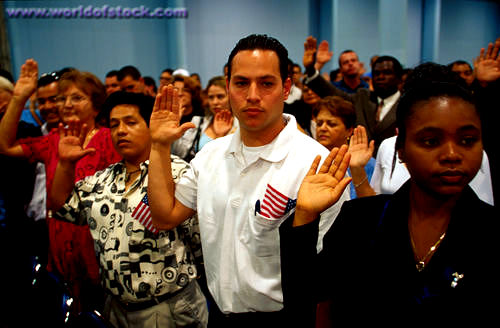
Friday, May 7, 2010
The New Atheists: Does Tone Matter?
As an outspoken and somewhat aggressive atheist who finds it effective to sometimes use ridicule to make strong points against often dishonest opponents, I often get the complaint that my 'tone' is objectionable...even from those who are also atheists or skeptics.
Often, we find ourselves in the skeptical community divided about 'tone', where some complain that the 'New Atheists' are too harsh, too polemic, and too sharp with our points to reach the masses. I've heard about this 'tone' argument pointed at Richard Dawkins, Christopher Hitchens, Sam Harris, Daniel Dennett, Vic Stenger, the Rational Response Squad, Massimo Pigliucci, Aron Ra of YouTube fame and many other outspoken non-believers.
But, how harsh is too harsh, and why the focus on TONE over the actual points being made?
My response to that is this: Tone matters, but various tones are needed. Those who complain about tone might think they're just trying to make us 'nicer' in response to some imaginary, honest and sensitive listener with an ear for nuance, while ignoring the fact that many theists aren't actually thinking, but bleating and repeating verse or beliefs, never having reviewed them and not honestly listening to critiques of their ridiculous claims.
In effect, focusing so much on 'tone' makes many atheist arguments less effective, and creates an unnecessary divide between the 'New Atheists' and those who are more passively atheist or who eschew the term 'atheist' altogether but share the non-theist position. The last thing atheists need is senseless subdivision. We need unity in this movement against irrationalism and religiosity now more than ever.
As we know, not everyone learns at the same rate or in the same manner. In matters of mass delusion such as religion, this de-conversion problem isn't merely about a lapse in logic. If this were the case, the person holding delusional beliefs such as 'god' would simply have the illogic of it explained which would instantly result in dismissal of erroneous belief(s), and we'd all talk about something else.
Such is not the case.
First, the mass-delusion of religion is not merely a logical sticking point but a deep-seated emotional issue. This emotional defense comes out of an almost blind defense of tradition, family and familiar ritual, and lives in a compartmentalized part of the religious mind often impervious to logical review. This is why the term 'freethinker' is so important, as a freethinker is someone whose views on religion transcend ritual, authority and tradition, but scrutinize religion openly and 'freely'. Someone who protects his religion in a bubble exempt from logic is by definition not a freethinker.
Alas, religion is not the product of logic, but primary socialization of trusting children, brainwashing and inculcation, societal reinforcement of demonstrably false ideas and a protection of investment and an unwillingless to face the truth despite a discomfiting cognitive dissonance.
Explain to a rational adult that you hold a dear belief that you are, in fact, an elf and you will be met with peals of laughter, derision, outright mockery and endless ridicule. No matter how deeply-held your belief, it'll simply be rejected on all fronts, and with various tones....but all leading to the same end result: denial and rejection. Your claim could be subject to review by scientists who could sequence your DNA, observation that you do not resemble an elf in any fashion, and counter-evidence that you in fact are Homo Sapiens with a specific lineage which can be traced to specific geographic locales.
Does tone matter to the recipient of said ridicule? Sure, and it probably scales with the lack of evidence. The person on the recieving end of this ridicule, and who honestly believes himself to be an elf, would much rather people simply believed him so he could get on with the business of actually being an elf, unopposed and unchallenged, as he believes himself (or she believes herself) to be. The elf-boy knows he cannot prove his claim, so his *only* recourse is to simply attempt to silence his critics and hang out with those who either avoid the subject or accept it without evidence.
The point here is that with enough ridicule, the silly ideas can't survive unless they're proven sufficiently to attract support. Those who practice science and deal with real data don't care about tone....they either verify or falsify their claims. You can bet their harshest critics are often other scientists. It's not about tone, it's about content. Those who complain about tone are simply trying to make criticism more bearable in a vacuum of evidence.
Tell enough people that you are Jesus and the holy and all-powerful son of God and you'll generally be laughed at or deemed crazy (often with very harsh tone), and this is in a culture where most Americans (and much of the world) believe in God.
Why are most Christians so quick to harshly reject the claim from some who might say, 'I am Jesus' or better yet, 'I am God' so harshly, and yet protect other nutty ideas about religion that their fellow believers claim? It's funny how some ridiculous claims are sacrosanct, and yet theists will openly and harshly reject other claims, even in the purview of their belief-system.
Go ahead, name your kid 'God', and see how people react and what kind of tone they use. Name him 'Jesus' and it's ok (as long as it's pronounced 'hay zoos' and the child appears Hispanic). Insist on people calling your kid 'Jee-zus' and you'll be in for a tough road ahead. Why the inconsistency? It's just people with silly beliefs arbitrarily protecting them based on culture and blind-tradition, and yet properly skeptical of claims which lie outside the immediate protection of their established religion.
Why the tonal difference between the treatment of the god-claim and elf-claim?
The God myth is popular in our English-speaking, largely-Christian culture, and people claiming to be Elves isn't. There are enough adults who believe in a God with a son named Jesus that this nutball idea has wide support with more 'converts' being made every day as innocent, trusting children are lied to about how the world works, from well-meaning but delusional parents.
Popular religious memes get un-due protection from scrutiny, are blindly defended by many, there's a built-in rule against doubt or scrutiny and there's public pressure to slander or silence the 'opposition' (whether that's perceived as atheists, sciences such as evolution, secularism in general, etc.). The American government even gets involved, violating the Constitution to promoting certain religions (Christianity) and religion over irreligion, such as the National Day of Prayer tradition. Incidentally, this unconstitutional government-endorsed religious favoritism was roundly defeated in a recent case; The Freedom From Religion Foundaton (FFRF.org) vs. President Obama. The ruling was made by Judge Barbara Crabb in yet another victory for secularism, and ultimately, for all Americans. If there's no freedom from religion then people can hardly expect to have freedom *of* religion, as the forefathers intended and the 1st amendment to the U.S. Constitution guarantees.
As Sam Harris said, (paraphrased), the 'moderates' out there provide comfort and cover for the fundamentalists. There is nobody providing cover for the 'I am an Elf' claim, nor is there cover for any god someone will invent next week. Popularity in effect lends support to a silly idea, but as we know historically, popularity is not a measure of validity. The ideas that the Earth was flat and the center of the Universe were no less wrong when they were popular than they are today.
Why then, with all the evil that comes from religion, are some skeptics so afraid of 'offending' theists with tone? This is exactly what unfounded claims need: skeptical inquiry, harsh and unrelenting review, unmitigated investigation and yes, sometimes ridicule is useful and effective. Some people simply won't respond to a review which is too obtuse, or too indirect, or too 'nice'. We can directly see how crazy some people get when their beliefs remain unchallenged too long, after all, how do people get to believe they are Jesus in the first place? They've clearly held a belief that a God exists, and somehow warped the religion they were taught into something else....a mutant form if you will.
Most children in America and in some other countries are also taught that Santa Claus is 'true', and invariably, they find out that Santa Claus is just a lie at a fairly young age. No matter how gently you put it, kids will generally react badly to this harsh reality...not because they don't understand the illogic of a guy in a red suit traveling around the world in one night or squeezing down chimneys (even where there's no chimney to be found), but because they suddenly *do* understand. The phenomenon we're seeing is an emotional reaction to a sudden realization (often accompanied by tears), a spontaneous change in worldview, a loss of investment, etc.
Adults are no different when confronted with devastating arguments about their god-beliefs, other than the fact that most are less resilient than children finding out that there's no Santa Claus. Instead of bursting into tears (which can sometimes happen), they act out in other ways...often harnessing their political, manipulative or even physical power to silence or distract the messenger from saying something that offends them, and threatens their investment in the dangerous mind-virus we call religion.
Once someone reaches adulthood, it can be very difficult to deprogram that person and bring them back to reality. Adults become set in their ways, are not as used to being challenged, and often have learned bad habits with regard to critical-thinking or lack critical-thinking skills. Adults who believe in fairy tales, while they may be able to operate a computer or solve math problems, often have a sense of investment in their bad ideas, and instead of thinking logically, often resort to a blind defense of home and hearth rather than thinking they were wrong all those years. Facing false beliefs late in life takes a unique combination of courage and intellectual honesty. Children will cry and then get over Santa Claus...but adults can linger in a quagmire of silly beliefs for years before they're able to shake certain delusions.
That said, the elf story is true. In high-school, some poor kid who had been clearly deluded by his parents gave an empassioned oral report about the fact that he was an Elf. At the end of the report the class erupted in peals of laughter....and at the time, I was a good Christian boy who believed that an all-powerful space-pixie sent himself down in the form of his own son to die for my sins, which is just as laughable.
So yes, tone matters, but not for the reasons often claimed. Tone matters because different 'tones' are effective for different people.
If your style of skeptical review is to be gentle, nice and not create too much of a stir but instead gently plant seeds, so be it. You will get through to earnest truth-seekers, but some will intimate you, talk over you, lead you through logical ruses (if you let them) and play all kinds of intellectually dishonest tricks. You will get through to some, but be completely ineffective with others.
Likewise, the world needs people who charge in head-on, tackle ideas without any mitigating softness and slay delusion wherever they find it. The hard-charging new atheist might turn off the delicate believers who might be swayed with a gentle demeanor, but they will often get through to those who are sufficiently embarrassed into re-thinking their position, because few people enjoy looking silly or stupid in public. It's the same motivation which causes people to double-check their zippers when leaving a restroom or make sure they don't have toilet paper stuck to the bottom of their shoes. People go to great lengths to avoid ridicule, and crazy ideas about super-pixies are not in any sense exempt.
This is why I usually find it pointless to argue with raving fundies in private. I've found their arguments are often way more ridiculous when they think nobody's looking...but debate them in public where you can point out every dishonest ruse, every disingenuous strawman and every ignored point and you will find the Fundy either runs for the hills or backs down, because they will eventually look stupid or dishonest if you challenge every unfounded assertion they try to build upon. This seems harsh, but remember, people hate feeling\looking stupid, even when it's a result of their own dishonesty (or stupidity). If you point out the errors in someone's argument often enough (and in front of an audience), the dishonest person holding the clearly disproven views should eventually back down, or at least lose credibility.
The no-nonsense, aggressive (new atheist) approach works wonders for these belligerent and aggressive theists, who think that putting atheists on the defensive is a good tactic to 'defend' theism. Those refuting religious claims need a a certain amount of intestinal fortitude to deal not only with someone who believes irrational ideas, but who uses dishonest techniques or might simply talk over you or make unfounded assertions on top of assertions, if not challenged early and often when these mistakes are made.
Remember, just being an atheist is already offensive to most theists, and according to most Bibles, is reason enough for you to land in someone's Hell. You may as well speak your mind. I recommend avoiding Ad-Hominem (character attacks), but be relentless in your intellectual review of any idea you find objectionable. Don't fall for ruses or distractions, don't let people talk over or silence you, and don't let them run away until you've made your closing statement.
Arguing with theists can be comical sometimes....as the closer you get to driving home a devastating point, the more they wriggle away. It's also comical that some theists complain about the New Atheists not being 'nice' while their very holy books have slandered non-believers for thousands of years....the Koran even recommends that the 'Infidel' (non-believer), be slayed wherever they are found. Arguing against theists isn't just about ideas, in a sense it's about divesting people of dangerous mind-viruses which cause real harm in the world in often unforseeable ways.
It's important to vehemently and forcefully resist this nonsense, because people are going to keep believing crazy stuff until there's a critical mass of people who don't believe it and are out of the closet about it. Only then will some of these ideas fall out of favor, but it takes effort. The reason we New Atheists seem so loud and strident, is because generally, we're the ones with the gumption to actually speak loudly against the hordes of believers who have been under-opposed for too long. It's not for the faint-of-heart. As more people speak up, a wider variety of voices will be heard, and perhaps the debate itself will dull as religion ceases to be so important (and dangerous) a force to reckon with.
Historically, many of us with unpopular ideas have often been silenced, often on pain of oppression, injury or death. I am sure many more would love to silence us again, but those days are long gone (at least in most of the world). Enjoy the various tonalities in this symphony we call the skeptical movement....the fact that we're being heard is something to celebrate, not argue about.
dB
Often, we find ourselves in the skeptical community divided about 'tone', where some complain that the 'New Atheists' are too harsh, too polemic, and too sharp with our points to reach the masses. I've heard about this 'tone' argument pointed at Richard Dawkins, Christopher Hitchens, Sam Harris, Daniel Dennett, Vic Stenger, the Rational Response Squad, Massimo Pigliucci, Aron Ra of YouTube fame and many other outspoken non-believers.
But, how harsh is too harsh, and why the focus on TONE over the actual points being made?
My response to that is this: Tone matters, but various tones are needed. Those who complain about tone might think they're just trying to make us 'nicer' in response to some imaginary, honest and sensitive listener with an ear for nuance, while ignoring the fact that many theists aren't actually thinking, but bleating and repeating verse or beliefs, never having reviewed them and not honestly listening to critiques of their ridiculous claims.
In effect, focusing so much on 'tone' makes many atheist arguments less effective, and creates an unnecessary divide between the 'New Atheists' and those who are more passively atheist or who eschew the term 'atheist' altogether but share the non-theist position. The last thing atheists need is senseless subdivision. We need unity in this movement against irrationalism and religiosity now more than ever.
As we know, not everyone learns at the same rate or in the same manner. In matters of mass delusion such as religion, this de-conversion problem isn't merely about a lapse in logic. If this were the case, the person holding delusional beliefs such as 'god' would simply have the illogic of it explained which would instantly result in dismissal of erroneous belief(s), and we'd all talk about something else.
Such is not the case.
First, the mass-delusion of religion is not merely a logical sticking point but a deep-seated emotional issue. This emotional defense comes out of an almost blind defense of tradition, family and familiar ritual, and lives in a compartmentalized part of the religious mind often impervious to logical review. This is why the term 'freethinker' is so important, as a freethinker is someone whose views on religion transcend ritual, authority and tradition, but scrutinize religion openly and 'freely'. Someone who protects his religion in a bubble exempt from logic is by definition not a freethinker.
Alas, religion is not the product of logic, but primary socialization of trusting children, brainwashing and inculcation, societal reinforcement of demonstrably false ideas and a protection of investment and an unwillingless to face the truth despite a discomfiting cognitive dissonance.
Explain to a rational adult that you hold a dear belief that you are, in fact, an elf and you will be met with peals of laughter, derision, outright mockery and endless ridicule. No matter how deeply-held your belief, it'll simply be rejected on all fronts, and with various tones....but all leading to the same end result: denial and rejection. Your claim could be subject to review by scientists who could sequence your DNA, observation that you do not resemble an elf in any fashion, and counter-evidence that you in fact are Homo Sapiens with a specific lineage which can be traced to specific geographic locales.
Does tone matter to the recipient of said ridicule? Sure, and it probably scales with the lack of evidence. The person on the recieving end of this ridicule, and who honestly believes himself to be an elf, would much rather people simply believed him so he could get on with the business of actually being an elf, unopposed and unchallenged, as he believes himself (or she believes herself) to be. The elf-boy knows he cannot prove his claim, so his *only* recourse is to simply attempt to silence his critics and hang out with those who either avoid the subject or accept it without evidence.
The point here is that with enough ridicule, the silly ideas can't survive unless they're proven sufficiently to attract support. Those who practice science and deal with real data don't care about tone....they either verify or falsify their claims. You can bet their harshest critics are often other scientists. It's not about tone, it's about content. Those who complain about tone are simply trying to make criticism more bearable in a vacuum of evidence.
Tell enough people that you are Jesus and the holy and all-powerful son of God and you'll generally be laughed at or deemed crazy (often with very harsh tone), and this is in a culture where most Americans (and much of the world) believe in God.
Why are most Christians so quick to harshly reject the claim from some who might say, 'I am Jesus' or better yet, 'I am God' so harshly, and yet protect other nutty ideas about religion that their fellow believers claim? It's funny how some ridiculous claims are sacrosanct, and yet theists will openly and harshly reject other claims, even in the purview of their belief-system.
Go ahead, name your kid 'God', and see how people react and what kind of tone they use. Name him 'Jesus' and it's ok (as long as it's pronounced 'hay zoos' and the child appears Hispanic). Insist on people calling your kid 'Jee-zus' and you'll be in for a tough road ahead. Why the inconsistency? It's just people with silly beliefs arbitrarily protecting them based on culture and blind-tradition, and yet properly skeptical of claims which lie outside the immediate protection of their established religion.
Why the tonal difference between the treatment of the god-claim and elf-claim?
The God myth is popular in our English-speaking, largely-Christian culture, and people claiming to be Elves isn't. There are enough adults who believe in a God with a son named Jesus that this nutball idea has wide support with more 'converts' being made every day as innocent, trusting children are lied to about how the world works, from well-meaning but delusional parents.
Popular religious memes get un-due protection from scrutiny, are blindly defended by many, there's a built-in rule against doubt or scrutiny and there's public pressure to slander or silence the 'opposition' (whether that's perceived as atheists, sciences such as evolution, secularism in general, etc.). The American government even gets involved, violating the Constitution to promoting certain religions (Christianity) and religion over irreligion, such as the National Day of Prayer tradition. Incidentally, this unconstitutional government-endorsed religious favoritism was roundly defeated in a recent case; The Freedom From Religion Foundaton (FFRF.org) vs. President Obama. The ruling was made by Judge Barbara Crabb in yet another victory for secularism, and ultimately, for all Americans. If there's no freedom from religion then people can hardly expect to have freedom *of* religion, as the forefathers intended and the 1st amendment to the U.S. Constitution guarantees.
As Sam Harris said, (paraphrased), the 'moderates' out there provide comfort and cover for the fundamentalists. There is nobody providing cover for the 'I am an Elf' claim, nor is there cover for any god someone will invent next week. Popularity in effect lends support to a silly idea, but as we know historically, popularity is not a measure of validity. The ideas that the Earth was flat and the center of the Universe were no less wrong when they were popular than they are today.
Why then, with all the evil that comes from religion, are some skeptics so afraid of 'offending' theists with tone? This is exactly what unfounded claims need: skeptical inquiry, harsh and unrelenting review, unmitigated investigation and yes, sometimes ridicule is useful and effective. Some people simply won't respond to a review which is too obtuse, or too indirect, or too 'nice'. We can directly see how crazy some people get when their beliefs remain unchallenged too long, after all, how do people get to believe they are Jesus in the first place? They've clearly held a belief that a God exists, and somehow warped the religion they were taught into something else....a mutant form if you will.
Most children in America and in some other countries are also taught that Santa Claus is 'true', and invariably, they find out that Santa Claus is just a lie at a fairly young age. No matter how gently you put it, kids will generally react badly to this harsh reality...not because they don't understand the illogic of a guy in a red suit traveling around the world in one night or squeezing down chimneys (even where there's no chimney to be found), but because they suddenly *do* understand. The phenomenon we're seeing is an emotional reaction to a sudden realization (often accompanied by tears), a spontaneous change in worldview, a loss of investment, etc.
Adults are no different when confronted with devastating arguments about their god-beliefs, other than the fact that most are less resilient than children finding out that there's no Santa Claus. Instead of bursting into tears (which can sometimes happen), they act out in other ways...often harnessing their political, manipulative or even physical power to silence or distract the messenger from saying something that offends them, and threatens their investment in the dangerous mind-virus we call religion.
Once someone reaches adulthood, it can be very difficult to deprogram that person and bring them back to reality. Adults become set in their ways, are not as used to being challenged, and often have learned bad habits with regard to critical-thinking or lack critical-thinking skills. Adults who believe in fairy tales, while they may be able to operate a computer or solve math problems, often have a sense of investment in their bad ideas, and instead of thinking logically, often resort to a blind defense of home and hearth rather than thinking they were wrong all those years. Facing false beliefs late in life takes a unique combination of courage and intellectual honesty. Children will cry and then get over Santa Claus...but adults can linger in a quagmire of silly beliefs for years before they're able to shake certain delusions.
That said, the elf story is true. In high-school, some poor kid who had been clearly deluded by his parents gave an empassioned oral report about the fact that he was an Elf. At the end of the report the class erupted in peals of laughter....and at the time, I was a good Christian boy who believed that an all-powerful space-pixie sent himself down in the form of his own son to die for my sins, which is just as laughable.
So yes, tone matters, but not for the reasons often claimed. Tone matters because different 'tones' are effective for different people.
If your style of skeptical review is to be gentle, nice and not create too much of a stir but instead gently plant seeds, so be it. You will get through to earnest truth-seekers, but some will intimate you, talk over you, lead you through logical ruses (if you let them) and play all kinds of intellectually dishonest tricks. You will get through to some, but be completely ineffective with others.
Likewise, the world needs people who charge in head-on, tackle ideas without any mitigating softness and slay delusion wherever they find it. The hard-charging new atheist might turn off the delicate believers who might be swayed with a gentle demeanor, but they will often get through to those who are sufficiently embarrassed into re-thinking their position, because few people enjoy looking silly or stupid in public. It's the same motivation which causes people to double-check their zippers when leaving a restroom or make sure they don't have toilet paper stuck to the bottom of their shoes. People go to great lengths to avoid ridicule, and crazy ideas about super-pixies are not in any sense exempt.
This is why I usually find it pointless to argue with raving fundies in private. I've found their arguments are often way more ridiculous when they think nobody's looking...but debate them in public where you can point out every dishonest ruse, every disingenuous strawman and every ignored point and you will find the Fundy either runs for the hills or backs down, because they will eventually look stupid or dishonest if you challenge every unfounded assertion they try to build upon. This seems harsh, but remember, people hate feeling\looking stupid, even when it's a result of their own dishonesty (or stupidity). If you point out the errors in someone's argument often enough (and in front of an audience), the dishonest person holding the clearly disproven views should eventually back down, or at least lose credibility.
The no-nonsense, aggressive (new atheist) approach works wonders for these belligerent and aggressive theists, who think that putting atheists on the defensive is a good tactic to 'defend' theism. Those refuting religious claims need a a certain amount of intestinal fortitude to deal not only with someone who believes irrational ideas, but who uses dishonest techniques or might simply talk over you or make unfounded assertions on top of assertions, if not challenged early and often when these mistakes are made.
Remember, just being an atheist is already offensive to most theists, and according to most Bibles, is reason enough for you to land in someone's Hell. You may as well speak your mind. I recommend avoiding Ad-Hominem (character attacks), but be relentless in your intellectual review of any idea you find objectionable. Don't fall for ruses or distractions, don't let people talk over or silence you, and don't let them run away until you've made your closing statement.
Arguing with theists can be comical sometimes....as the closer you get to driving home a devastating point, the more they wriggle away. It's also comical that some theists complain about the New Atheists not being 'nice' while their very holy books have slandered non-believers for thousands of years....the Koran even recommends that the 'Infidel' (non-believer), be slayed wherever they are found. Arguing against theists isn't just about ideas, in a sense it's about divesting people of dangerous mind-viruses which cause real harm in the world in often unforseeable ways.
It's important to vehemently and forcefully resist this nonsense, because people are going to keep believing crazy stuff until there's a critical mass of people who don't believe it and are out of the closet about it. Only then will some of these ideas fall out of favor, but it takes effort. The reason we New Atheists seem so loud and strident, is because generally, we're the ones with the gumption to actually speak loudly against the hordes of believers who have been under-opposed for too long. It's not for the faint-of-heart. As more people speak up, a wider variety of voices will be heard, and perhaps the debate itself will dull as religion ceases to be so important (and dangerous) a force to reckon with.
Historically, many of us with unpopular ideas have often been silenced, often on pain of oppression, injury or death. I am sure many more would love to silence us again, but those days are long gone (at least in most of the world). Enjoy the various tonalities in this symphony we call the skeptical movement....the fact that we're being heard is something to celebrate, not argue about.
dB
Sunday, May 2, 2010
Hal Bidlack: Can a deist (or theist) be a (good) skeptic?
I'm a fan of podcasts, especially podcasts relating to skepticism and atheism.
I just listened to a skeptically-oriented podcast called 'Skepticality' (episode 57) as I've been working my way through past episodes. This particular show featured Dr. Hal Bidlack, an esteemed-member of the James Randi Educational foundation which holds a yearly gathering of skeptics called 'The Amazing Meeting' aka 'TAM'.
James 'The Amazing' Randi plied his early trade as a magician and illusionist, but like Harry Houdini of our time, he's also a lifelong skeptic. Randi appeared on the Johnny Carson show numerous times and has traveled around the world debunking false claims and woo such as those perpetuated by spoon-bender Uri Geller, faith 'healers' such as Peter Popoff and self-proclaimed 'psychics' such as Sylvia Browne.
Most famously, The Randi Foundation has for a long time offered the Million Dollar Challenge to anyone (including Geller, Popoff and Browne) who can prove claimed supernatural abilities under controlled, mututually agreed-upon conditions. Nobody has claimed the million dollars, much less even passed the screening process.
As Master of Ceremonies for the Randi Foundation's 'Amazing Meeting', Hal Bidlack is a self-labeled skeptic who also calls himself a 'deist'. Therein lies the conflict. How is it that a self-labeled deist is also Master of Ceremonies at one of the most famous skeptical organizations in the world? Please note, this is not to say he shouldn't be Master of Ceremonies, nor is my intent to infer that he shouldn't be welcome in any sense...the skeptical community needs all the members it can get.
My question is, how can someone (not just Hal) call himself a skeptic but manage to hold the idea that some kind of 'God' exists or existed in the past?
Let's clarify what a 'deist' is. A deist believes that there is a non-intervening God....and that basically a 'God' of some undefined sort basically spun the Universe into motion and stopped answering phone calls...forever.
In this episode of Skepticality, Bidlack has a monologue. Here are some quotes relating to his deism and his understandable lamentation about conflicts with skepticism. You might spot why I take issue with his stance on his deism and how his insecurity about this causes him to be a bit disenfranchised with the 'skeptical movement'....
The astute reader will see that Hal is basically inferring that these atheists are akin to a religion, even making note of their pamphleteering. Medical doctors and pharmacists hand out pamphlets too, but I digress.
Atheism is merely a rejection or lack of theism, and it's a response to a claim. The deist may cover 'how it began' with a god, but a non-intervening God is effectively the same as 'no god', in practice, just like atheism would be justified to the claim that God simply 'went away for a few billion years but is coming back'.
Naturally, any God who would take the time to prove itself would be thoughtfully considered, but the evidence is just not there and likely won't be coming anytime soon. Dr. Bidlack is employing the fallacy of extremes here, thinking there is some safe middle ground between atheism/theism, which for him is deism. However, I don't consider the position of atheist any more 'extremist' than the position of 'a-Zeusist' or 'a-SantaClausist'. Therefore, there is no more 'zealotry' in rejecting the wild claim of 'God exists' than one would reject the claim that 'Shukulakamaka the invisible gas-god of inner Jupiter exists'. Comparing atheists to zealots is simply misguided, and belies the sensitivity Hal has about his deism.
The mistake Hal makes here is how he mis-characterizes atheism or atheists, in that we hold an absolute position. He commits a strawman fallacy.
A correctly-held skeptical and provisional rejection of an untestable, incoherent claim is by no means any form of extremism, any more than not believing in green-spotted Cephalopods from planet Venus is a form of extremism. When faced with a wild, untested claim, the innocent bystander rejecting the claim is not an extremist but instead, a person employing healthy skepticism. After all, there cannot both 'be a god' and 'not be a god' concurrently. Either there is or there isn't, and thus far, all the evidence lacking for any god claim leaves atheism as not an extreme 'position' but a reasonable default.
Likewise, abolitionists were not extremists in their opposition to slavery any more than those who supported women's rights were 'extremist' in their response to the oppression of women.
Hal Bidlack spoke at TAM 4 in 2006, in support of his deism, interwoven with emotional appeals and even, a sense that he knows his deism isn't rational. This is all well and good, but there's no reason to complain about atheists being 'too critical' of his notably irrational deism....this is what skeptics do! They scrutinize claims....and if one holds a claim which is 'off limits' it becomes little more than special pleading.
Here's an excerpt from the introduction:
Without going into the whole speech, suffice it to say that Hal's reasons for deism are more appeals to emotion than rationality as he gives empassioned recollections of his wife's battle with cancer and his direct experience with the aftermath of the 911 attacks.
Speaking generally, it's ok to simply define your faith as a compartmentalized view you have about the supernatural without trying to rationalize it or attempting to paint skeptics with the same brush as zealots. Atheists and the religious are not two 'extremes' on a scale other than one is simply rejecting the claim of the rest, exactly in the same way most theists reject every other religious claim they hear.
Attacking the default and reasonable position of atheism as some kind of ruse will only result in more and more intense skeptical review of your own ideas which don't hold water. It's far more honest and direct for the theist to simply admit where he's inconsistent and deal with the compatible issues...in Hal's case, his shared skepticism with those that, 'walk with him' as he puts it.
Of course, one can practice skepticism and be a deist. One can also be a skeptic and be a theist, such as the Christian who may work as a scientific researcher...using his skeptical brain at work, but using a religious part of his compartmentalized brain in church. But, there is a caveat. If one holds certain beliefs 'off-limits' from his skepticism, then at best, that person is simply inconsistent and not as good of a skeptic as he/she could be.
Theists of all types manage to operate microwave ovens, drive cars, solve puzzles, patent inventions and reject some pseudoscience, scams and assorted woo. However, theists by definition accept some supernatural claims as 'Truth®' or they wouldn't be theists. Theists have varying levels of skepticism, but by definition employ 'exceptions' which allows them to maintain the cognitive dissonance that is religion in a modern world. In Dr. Bidlack's case, he may consider himself a good skeptic, but his appeal for exemption with regard to his Deism is nothing less than a fallacy of special pleading.
While some theists may call themselves 'skeptics', they're just not consistent, since by definition a theist who believes in an untestable 'god' hasn't discovered or managed to emotionally accept the reasons a god cannot exist, as defined.
Some people in general will be better skeptics than others and the degree to which skepticism is practiced varies wildly. Likewise, some intellectually brave or honest theists will actually be able to overcome the emotional draw of their religion. I say 'brave' because challenging what you genuinely believe to be the creator of the Universe is no small task. I know, because I did it, and it took a brave and honest intellectual view to do that.
It's sort of like finally standing up to the large and over-developed high-school bully and discovering he's a total wimp or in the case of God, he's not even there. The Wizard of Oz is the same story, and most of us are familiar with that. Suddenly, the bully-problem is gone, but that doesn't change the amount of fear and trepidation which preceded that confrontation. Often, the fear and emotional issues are worse than the problem itself.
My own Christianity was challenged by the first atheist I debated at age 20, and it took about a month for me to fully reject the belief, after a lot of debate, late-night Bible reading and sleepless angst. This was me being skeptical about my *own* views, as difficult as it was, and being consistent. How could I be a good skeptic but call my own irrational beliefs 'off-limits' for emotion or any other reason?
If you're going to call yourself a skeptic and yet knowingly hold an irrational, unfalsifiable belief in a 'God' which you insist is outside the scope of science....and if said God cannot be explained coherently or rationally and is more of an appeal to emotion than logical theory, than you are simply putting your skepticism on hold for this particular idea. In THAT instance, you are not a skeptic (or not an honest or consistent one).
Those who knowingly hold irrational beliefs shouldn't resort to emotional appeals or special pleading. At least, they should expect other skeptics to openly review these vulnerable ideas. Those who somehow think both theism and atheism are 'extremes' fall into the split the difference fallacy, as if the 'Truth' lies between two. Is there a middle ground between the claim of Allah or the Flying Spaghetti Monster and the rejection of this claim as true? How about the claim that men should own slaves, and the rejection of this idea based on the notion that humans should be treated equally?
Let's not insult atheists by implying that they're somehow 'militant' (taking up arms) or misrepresent atheism as some 'absolute' position when you hold a belief in a space-pixie due to an appeal to ignorance or emotion. This is a mere distraction, and doesn't weaken atheism (which is simply a reponse to a claim) but instead belies an insecurity in whatever you're trying to protect from scrutiny.
Yes, I admire any skeptical work Hal Bidlack and other theist/deist skeptics might be doing and if he ran for office where I lived, I'd probably be glad to vote for him (since we agree on so much). However those who refuse to apply scrutiny to some of their own ideas are simply not being the best skeptics they could be, and shouldn't complain (or be surprised) when others enthusiastically review their ideas on their behalf.
There are some excellent defenders of church-state separation who believe in a God such as Reverend Barry Lynn of Americans United for the Separation of Church and State. Does that make Rev. Lynn and his organization any less effective at defending church-state separation? No. Does that make them good skeptics? Debatable, but it's a different issue. I may disagree with Rev. Lynn about his God-belief, but I highly value the work he's doing to help promote church-state separation as guaranteed in the first amendment to the U.S. Constitution. However, if Barry Lynn were to make a claim that atheists are in some sense wrong or 'extreme', his own beliefs would come under intense scrutiny, and he wouldn't have a leg to stand on. But, I would just as soon let sleeping dogs lie while he continues his valuable work with Americans United.
Remember, the enemy of my enemy is my friend. Sometimes, we find alliances in those who may not be just like us, but they are allies just the same. I for one accept and admire those who strive to be skeptics, even if they're not quite as skeptical as I'd like them to be. Some may feel I am being a bit hard on Hal and others who are allies in this skeptical movement, but my point here is that there are no exceptions. No idea is sacrosanct or exempt from scrutiny....yes, even the ideas of my fellow-allies in the skeptical movement. Believe me, I understand that we need every skeptic willing to help usher-in critical thinking....but we skeptics need to bear in mind that we are never personally exempt.
To be fair, I am sure there are atheists somewhere who don't believe humans landed on the moon, or that believe the tripe Jenny McCarthy spreads about the 'danger' of vaccines. Simply being an atheist doesn't mean one is inherently more skeptical, but calling one's self a 'skeptic' means you shouldn't make exceptions, no matter how uncomfortable it might be. I actually met an atheist once who was homophobic. I can assure you that this isn't common, but he seemed impervious to the scientifically-verified fact that homosexuality is congenital, cannot be 'changed' by mere suppression and exists almost always at a 10% baseline level in human populations and to varying degrees in other animal species as well.
As with anything, people have skeptical lapses, and there is often room for improvement. I applaud those who strive to be skeptical and who value critical-thinking, but none of us are immune from the critical eye of others...it's what keeps the 'critical' in critical thinking, and though it's sometimes painful, it keeps us honest.
Plus, it's something to talk about over lunch. ;)
-dB-
I just listened to a skeptically-oriented podcast called 'Skepticality' (episode 57) as I've been working my way through past episodes. This particular show featured Dr. Hal Bidlack, an esteemed-member of the James Randi Educational foundation which holds a yearly gathering of skeptics called 'The Amazing Meeting' aka 'TAM'.
James 'The Amazing' Randi plied his early trade as a magician and illusionist, but like Harry Houdini of our time, he's also a lifelong skeptic. Randi appeared on the Johnny Carson show numerous times and has traveled around the world debunking false claims and woo such as those perpetuated by spoon-bender Uri Geller, faith 'healers' such as Peter Popoff and self-proclaimed 'psychics' such as Sylvia Browne.
Most famously, The Randi Foundation has for a long time offered the Million Dollar Challenge to anyone (including Geller, Popoff and Browne) who can prove claimed supernatural abilities under controlled, mututually agreed-upon conditions. Nobody has claimed the million dollars, much less even passed the screening process.
As Master of Ceremonies for the Randi Foundation's 'Amazing Meeting', Hal Bidlack is a self-labeled skeptic who also calls himself a 'deist'. Therein lies the conflict. How is it that a self-labeled deist is also Master of Ceremonies at one of the most famous skeptical organizations in the world? Please note, this is not to say he shouldn't be Master of Ceremonies, nor is my intent to infer that he shouldn't be welcome in any sense...the skeptical community needs all the members it can get.
My question is, how can someone (not just Hal) call himself a skeptic but manage to hold the idea that some kind of 'God' exists or existed in the past?
Let's clarify what a 'deist' is. A deist believes that there is a non-intervening God....and that basically a 'God' of some undefined sort basically spun the Universe into motion and stopped answering phone calls...forever.
In this episode of Skepticality, Bidlack has a monologue. Here are some quotes relating to his deism and his understandable lamentation about conflicts with skepticism. You might spot why I take issue with his stance on his deism and how his insecurity about this causes him to be a bit disenfranchised with the 'skeptical movement'....
'...and thus it pains me to find myself increasingly uncomfortable in the company of skeptics who seem intent sometimes to bring an opposite and equal fundamentalist passion to issues of faith. At TAM 5 no less than three well-intentioned individuals attempted to save me from my non-atheism (one even had pamphlets)....and they did so with no less ardor than the religious zealots bring to their cause'.
The astute reader will see that Hal is basically inferring that these atheists are akin to a religion, even making note of their pamphleteering. Medical doctors and pharmacists hand out pamphlets too, but I digress.
Atheism is merely a rejection or lack of theism, and it's a response to a claim. The deist may cover 'how it began' with a god, but a non-intervening God is effectively the same as 'no god', in practice, just like atheism would be justified to the claim that God simply 'went away for a few billion years but is coming back'.
Naturally, any God who would take the time to prove itself would be thoughtfully considered, but the evidence is just not there and likely won't be coming anytime soon. Dr. Bidlack is employing the fallacy of extremes here, thinking there is some safe middle ground between atheism/theism, which for him is deism. However, I don't consider the position of atheist any more 'extremist' than the position of 'a-Zeusist' or 'a-SantaClausist'. Therefore, there is no more 'zealotry' in rejecting the wild claim of 'God exists' than one would reject the claim that 'Shukulakamaka the invisible gas-god of inner Jupiter exists'. Comparing atheists to zealots is simply misguided, and belies the sensitivity Hal has about his deism.
'And thus a great passion in my life, skepticism, is becoming a more and more difficult path. I find myself more and more drawn to the mission and yet more and more estranged from those who walk with me.'
'It is not without irony to note that the methods of religious extremists pushed moderates away from a particular faith. And within the skeptical movement, those who insist that atheism is the only single correct worldview and that it must be the lens with which all critical issues are viewed, well they pushed me away'.
The mistake Hal makes here is how he mis-characterizes atheism or atheists, in that we hold an absolute position. He commits a strawman fallacy.
A correctly-held skeptical and provisional rejection of an untestable, incoherent claim is by no means any form of extremism, any more than not believing in green-spotted Cephalopods from planet Venus is a form of extremism. When faced with a wild, untested claim, the innocent bystander rejecting the claim is not an extremist but instead, a person employing healthy skepticism. After all, there cannot both 'be a god' and 'not be a god' concurrently. Either there is or there isn't, and thus far, all the evidence lacking for any god claim leaves atheism as not an extreme 'position' but a reasonable default.
Likewise, abolitionists were not extremists in their opposition to slavery any more than those who supported women's rights were 'extremist' in their response to the oppression of women.
Hal Bidlack spoke at TAM 4 in 2006, in support of his deism, interwoven with emotional appeals and even, a sense that he knows his deism isn't rational. This is all well and good, but there's no reason to complain about atheists being 'too critical' of his notably irrational deism....this is what skeptics do! They scrutinize claims....and if one holds a claim which is 'off limits' it becomes little more than special pleading.
Here's an excerpt from the introduction:
'...if you are keeping score, appeal to emotion will be a recurring one for me today. But as we are all friends here, I shall chance it. I suspect that only a very few are able to move through life with unwavering belief systems. I am not one of those people. I am in many things, inconsistent'.
Without going into the whole speech, suffice it to say that Hal's reasons for deism are more appeals to emotion than rationality as he gives empassioned recollections of his wife's battle with cancer and his direct experience with the aftermath of the 911 attacks.
Speaking generally, it's ok to simply define your faith as a compartmentalized view you have about the supernatural without trying to rationalize it or attempting to paint skeptics with the same brush as zealots. Atheists and the religious are not two 'extremes' on a scale other than one is simply rejecting the claim of the rest, exactly in the same way most theists reject every other religious claim they hear.
Attacking the default and reasonable position of atheism as some kind of ruse will only result in more and more intense skeptical review of your own ideas which don't hold water. It's far more honest and direct for the theist to simply admit where he's inconsistent and deal with the compatible issues...in Hal's case, his shared skepticism with those that, 'walk with him' as he puts it.
Of course, one can practice skepticism and be a deist. One can also be a skeptic and be a theist, such as the Christian who may work as a scientific researcher...using his skeptical brain at work, but using a religious part of his compartmentalized brain in church. But, there is a caveat. If one holds certain beliefs 'off-limits' from his skepticism, then at best, that person is simply inconsistent and not as good of a skeptic as he/she could be.
Theists of all types manage to operate microwave ovens, drive cars, solve puzzles, patent inventions and reject some pseudoscience, scams and assorted woo. However, theists by definition accept some supernatural claims as 'Truth®' or they wouldn't be theists. Theists have varying levels of skepticism, but by definition employ 'exceptions' which allows them to maintain the cognitive dissonance that is religion in a modern world. In Dr. Bidlack's case, he may consider himself a good skeptic, but his appeal for exemption with regard to his Deism is nothing less than a fallacy of special pleading.
While some theists may call themselves 'skeptics', they're just not consistent, since by definition a theist who believes in an untestable 'god' hasn't discovered or managed to emotionally accept the reasons a god cannot exist, as defined.
Some people in general will be better skeptics than others and the degree to which skepticism is practiced varies wildly. Likewise, some intellectually brave or honest theists will actually be able to overcome the emotional draw of their religion. I say 'brave' because challenging what you genuinely believe to be the creator of the Universe is no small task. I know, because I did it, and it took a brave and honest intellectual view to do that.
It's sort of like finally standing up to the large and over-developed high-school bully and discovering he's a total wimp or in the case of God, he's not even there. The Wizard of Oz is the same story, and most of us are familiar with that. Suddenly, the bully-problem is gone, but that doesn't change the amount of fear and trepidation which preceded that confrontation. Often, the fear and emotional issues are worse than the problem itself.
My own Christianity was challenged by the first atheist I debated at age 20, and it took about a month for me to fully reject the belief, after a lot of debate, late-night Bible reading and sleepless angst. This was me being skeptical about my *own* views, as difficult as it was, and being consistent. How could I be a good skeptic but call my own irrational beliefs 'off-limits' for emotion or any other reason?
If you're going to call yourself a skeptic and yet knowingly hold an irrational, unfalsifiable belief in a 'God' which you insist is outside the scope of science....and if said God cannot be explained coherently or rationally and is more of an appeal to emotion than logical theory, than you are simply putting your skepticism on hold for this particular idea. In THAT instance, you are not a skeptic (or not an honest or consistent one).
Those who knowingly hold irrational beliefs shouldn't resort to emotional appeals or special pleading. At least, they should expect other skeptics to openly review these vulnerable ideas. Those who somehow think both theism and atheism are 'extremes' fall into the split the difference fallacy, as if the 'Truth' lies between two. Is there a middle ground between the claim of Allah or the Flying Spaghetti Monster and the rejection of this claim as true? How about the claim that men should own slaves, and the rejection of this idea based on the notion that humans should be treated equally?
Let's not insult atheists by implying that they're somehow 'militant' (taking up arms) or misrepresent atheism as some 'absolute' position when you hold a belief in a space-pixie due to an appeal to ignorance or emotion. This is a mere distraction, and doesn't weaken atheism (which is simply a reponse to a claim) but instead belies an insecurity in whatever you're trying to protect from scrutiny.
Yes, I admire any skeptical work Hal Bidlack and other theist/deist skeptics might be doing and if he ran for office where I lived, I'd probably be glad to vote for him (since we agree on so much). However those who refuse to apply scrutiny to some of their own ideas are simply not being the best skeptics they could be, and shouldn't complain (or be surprised) when others enthusiastically review their ideas on their behalf.
There are some excellent defenders of church-state separation who believe in a God such as Reverend Barry Lynn of Americans United for the Separation of Church and State. Does that make Rev. Lynn and his organization any less effective at defending church-state separation? No. Does that make them good skeptics? Debatable, but it's a different issue. I may disagree with Rev. Lynn about his God-belief, but I highly value the work he's doing to help promote church-state separation as guaranteed in the first amendment to the U.S. Constitution. However, if Barry Lynn were to make a claim that atheists are in some sense wrong or 'extreme', his own beliefs would come under intense scrutiny, and he wouldn't have a leg to stand on. But, I would just as soon let sleeping dogs lie while he continues his valuable work with Americans United.
Remember, the enemy of my enemy is my friend. Sometimes, we find alliances in those who may not be just like us, but they are allies just the same. I for one accept and admire those who strive to be skeptics, even if they're not quite as skeptical as I'd like them to be. Some may feel I am being a bit hard on Hal and others who are allies in this skeptical movement, but my point here is that there are no exceptions. No idea is sacrosanct or exempt from scrutiny....yes, even the ideas of my fellow-allies in the skeptical movement. Believe me, I understand that we need every skeptic willing to help usher-in critical thinking....but we skeptics need to bear in mind that we are never personally exempt.
To be fair, I am sure there are atheists somewhere who don't believe humans landed on the moon, or that believe the tripe Jenny McCarthy spreads about the 'danger' of vaccines. Simply being an atheist doesn't mean one is inherently more skeptical, but calling one's self a 'skeptic' means you shouldn't make exceptions, no matter how uncomfortable it might be. I actually met an atheist once who was homophobic. I can assure you that this isn't common, but he seemed impervious to the scientifically-verified fact that homosexuality is congenital, cannot be 'changed' by mere suppression and exists almost always at a 10% baseline level in human populations and to varying degrees in other animal species as well.
As with anything, people have skeptical lapses, and there is often room for improvement. I applaud those who strive to be skeptical and who value critical-thinking, but none of us are immune from the critical eye of others...it's what keeps the 'critical' in critical thinking, and though it's sometimes painful, it keeps us honest.
Plus, it's something to talk about over lunch. ;)
-dB-
Subscribe to:
Posts (Atom)

 Atheist Angle RSS Feed